
At a glance
- Diagnose first. Most warehouse roof leaks start at laps, fixings, rooflights, gutters and cut edges. Some "leaks" are really condensation.
- There are three routes: coat the existing roof, overclad it with a new roof on top, or strip it and replace it.
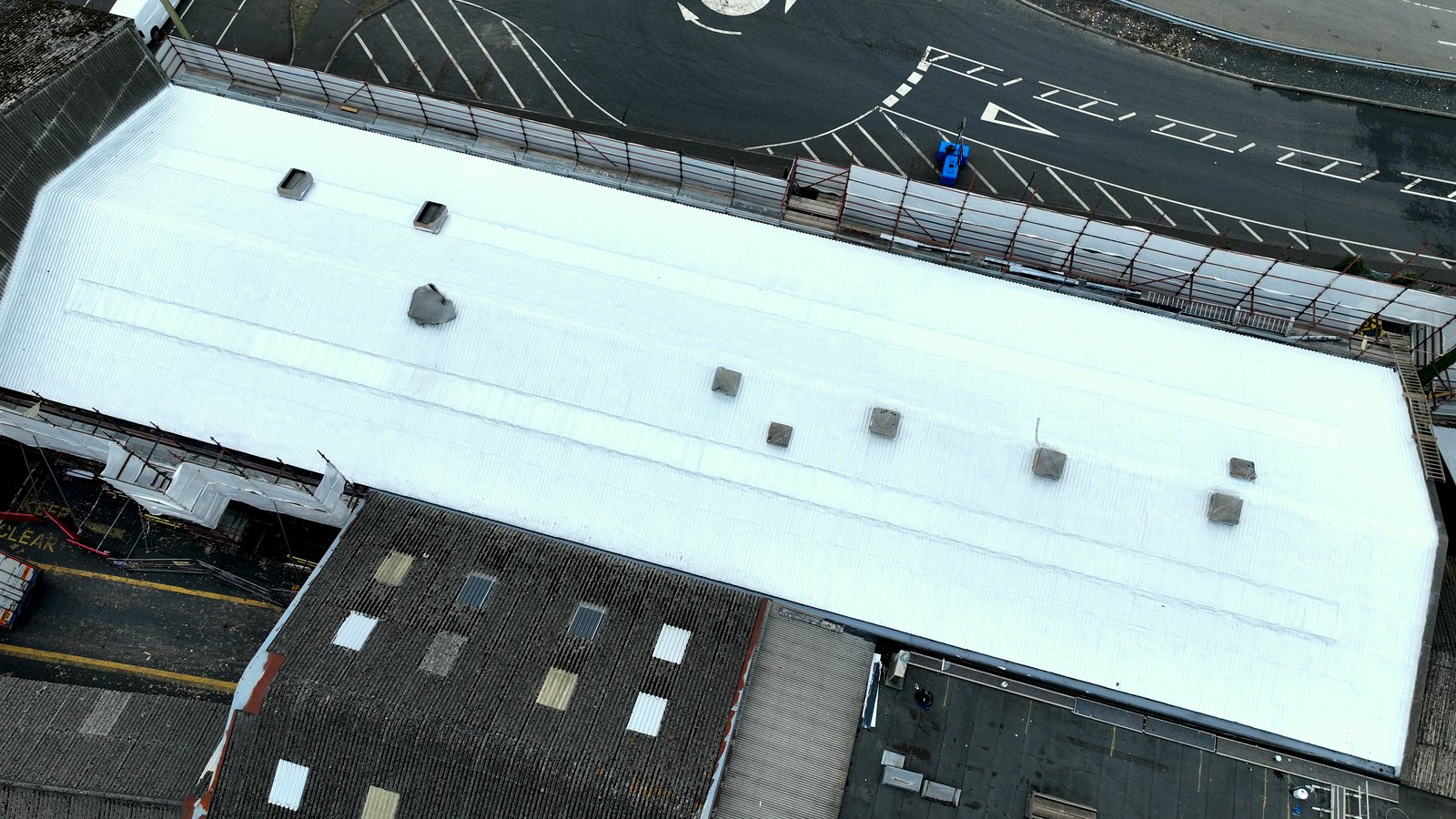
- Coating is the least disruptive where the sheets and structure are sound: cold-applied, no strip-out, minimal waste, and the building usually keeps trading underneath.
- Asbestos cement roofs follow the asbestos regulations. In the Republic, notifiable work needs an HSA permit before it starts. In Northern Ireland, HSENI regulates it.
- You can insulate at the same time with closed-cell spray foam on the underside. Every roof is priced after a free site survey.
Diagnose before you choose
Warehouse roofs rarely leak in the middle of a sheet. They leak where something joins, moves or has been cut. Before comparing prices for anything, find out which of these you have:
- Side and end laps. Sealant strips perish and laps open up as the roof moves with temperature.
- Fixings. Washers harden and split, fixings loosen, and water tracks down the shank.
- Rooflights. Older rooflight sheets go brittle and crack, and their laps with the metal sheets fail.
- Gutters. Valley and box gutters corrode, joints open, and blocked outlets send water over the edge and back into the building.
- Cut edges. Coated steel sheets corrode first where they were cut in the factory, and the rust creeps back from the edge. See cut-edge corrosion treatment.
- Flashings and penetrations. Ridge, verge and wall flashings, vents, flues and plant bases.
- Condensation. Drips after cold, clear nights with no rain are usually condensation, not a leak. See why metal roofs drip.
A proper survey looks at the roof from safe access, inside the building during or after rain, and at the gutters and rooflights in detail. Photographs and a marked-up roof plan should come with the report.
Fragile roofs: rooflights and asbestos cement sheets will not take a person's weight. Nobody should walk a warehouse roof without a safe system of work, including for "just a quick look".
Coat, overclad or replace: compared
| Coat | Overclad | Replace | |
|---|---|---|---|
| What happens | Existing roof cleaned, details sealed, liquid membrane applied | New sheets fixed over the old roof on a spacer system | Old roof stripped, new roof built |
| Disruption inside | Usually minimal, work is above | Moderate, fixings through the old roof | High, the roof is open during works |
| Hot works | None with a cold-applied coating | Depends on the system | Depends on the system |
| Waste | Minimal | Some | A full roof, hazardous if asbestos |
| Programme | No strip-out stage | Adds structure, sheeting and flashing stages | Strip-out plus a new roof |
| Structural check | Condition survey | Added load on purlins and frame | Full design |
| Adds insulation | No, unless foam is added | Yes, in the new build-up | Yes, in the new build-up |
| Not right when | Sheets are corroded through or the structure has failed | The frame cannot take the load | A sound roof only needs its details sealing |
General comparison. The survey decides what suits your roof.
For most warehouses with sound sheets and leaking details, coating is the first option to price. It is not always the answer, and a survey that recommends it for every roof is not a survey.
Coating a warehouse roof: what is involved
A liquid coating system waterproofs the existing roof in place. On a metal warehouse roof the usual sequence is:
- Repairs. Sheets that have rusted through and broken rooflights are replaced, and gutters repaired.
- Clean. Dirt, loose rust and organic growth are removed so the coating bonds to the roof.
- Corrosion and cut edges. Rust is treated and cut edges sealed.
- Details. GacoFlex SF42, the fibre-reinforced silicone seam sealant, goes over laps, fixings, rooflight upstands and penetrations. The reinforcement is built in, so no separate fabric or mesh is needed.
- Coat. GacoFlex S42 silicone goes over the whole roof to the specified film, with wet-film readings recorded.
A complete S42 system carries a 20-year manufacturer-backed product warranty. S42 is cold-applied, so there are no torches on the roof. Where a urethane system suits better, for example over roofing foam, GacoFlex U91 and U92 are the alternative. See silicone roof coating for the full system and commercial roof leak repair for smaller jobs.
Leaking warehouse roof?
Send photos of the roof and the drips, and the building address. An approved installer will survey it and set out the right route.
When overcladding or replacement is the better answer
Coating is the wrong answer when:
- large areas of sheet have corroded through, not just at the edges;
- purlins, fixings or the frame have deteriorated;
- the building is being converted or extended and needs a new roof build-up anyway;
- the owner wants a high level of insulation above the deck.
An overclad adds a new roof over the old one. It needs a structural engineer to check the extra load and a design for the new fixings and flashings. Replacement removes the problem completely, at the cost of the biggest disruption and the most waste.
Either route may bring the energy side of the Building Regulations into play. Where roof work counts as a material alteration or works to a thermal element, TGD L 2022 Table 10 sets 0.25 W/m²K for a pitched roof insulated on the slope and 0.25 W/m²K for a flat roof. Your designer or assigned certifier confirms whether that applies. In Northern Ireland the equivalent guidance is Technical Booklet F2.
Asbestos cement warehouse roofs
Many older Irish warehouses, factories and farm buildings have asbestos cement roofs. Stripping one means handling and disposing of a full roof of hazardous waste. Sealing it in place avoids that, where the sheets are sound enough.
The work follows the asbestos regulations. In the Republic, the Exposure to Asbestos Regulations 2006–2025 apply and notifiable work needs an HSA permit issued before it begins. Read asbestos regulations in Ireland first.
The SAICA Warrenpoint case study in County Down is a working example. The asbestos cement roof on Unit 3, 1,090 m², was sealed with closed-cell roofing foam and a GacoFlex U91 base coat and U92 top coat, instead of being stripped. The works were notified to HSENI. See asbestos roof coatings and warehouse asbestos roof waterproofing.
Keeping the building operational
For most warehouse owners the real cost of a roof job is disruption. A coating route is planned to avoid it:
- The roof stays closed. Work happens on top of the existing sheets, so the building is never open to the weather.
- Safe working above people. Edge protection, protection over rooflights and, where needed, netting underneath fragile areas are set up before work starts.
- Zones and sequencing. The roof is done in sections around loading bays, picking areas and deliveries.
- Weather windows. Each section is cleaned, detailed and coated in a dry window and left to cure.
- Clear communication. Site contacts, working hours and restricted areas are agreed before the start date.
Insulating at the same time
A roof coating waterproofs. It does not insulate. If the warehouse is cold, expensive to heat or drips condensation, add insulation to the plan while access is being arranged.
Closed-cell spray foam applied to the underside of the sheets insulates the roof, seals laps and fixings from inside and stops condensation, with no brackets or fixings through the sheet. Enverge Nexseal LE, for example, has a declared thermal conductivity of 0.027 W/m·K and a 25-year manufacturer-backed product warranty. See warehouse insulation and our warehouse insulation guide.
Fix the leaks first. Foam on the underside of a leaking roof hides the leak.
How pricing works
We do not publish prices per square metre for roof repairs, because the number would be wrong for most roofs. The price depends on:
- the roof area and pitch, and how complicated it is;
- access, edge protection and fragile-roof protection;
- the condition of sheets, fixings, rooflights and gutters, and how much repair is needed first;
- the amount of detail work at laps, fixings and penetrations;
- whether the roof is asbestos cement, and the regulatory process that follows;
- whether insulation is added underneath.
Every roof is priced after a free site survey. An approved installer surveys the roof and gives you a fixed quote with a clear scope, so you are comparing like with like.