
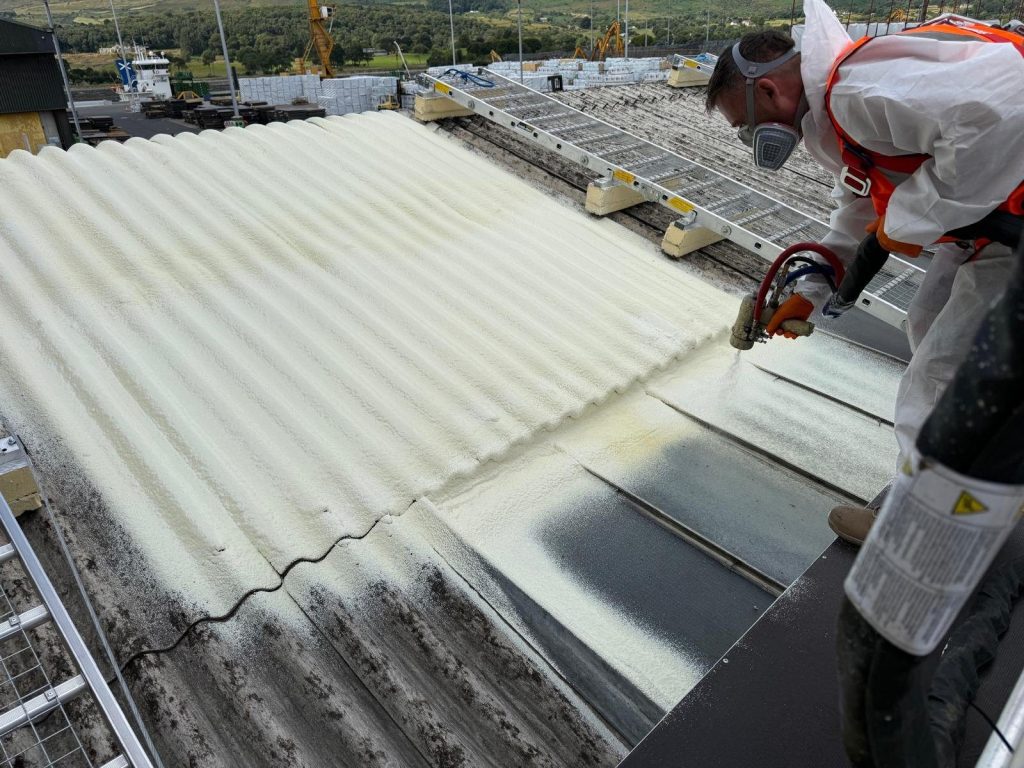
Foam from the walkways
SAICA, Warrenpoint, County Down: closed-cell roofing foam spray-applied from the walkway system over asbestos cement (Northern Ireland project).
Fragile-roof walkwaysNo one on the sheets
Spray foam insulation for Dublin farm, industrial and commercial buildings — surveyed free, specified to the building and installed by approved installers.
If you own or manage an agricultural, industrial or commercial building in Dublin and the wider County Dublin area, spray foam is one of the few insulation methods that can be applied to the existing structure with the building left standing and, in many cases, in use. Duratite Ireland matches your enquiry to an approved installer who covers County Dublin.
Both ranges are declared to EN 14315-1 and CE marked. The foam self-bonds to the substrate as it cures — no mechanical fixings. The right product and thickness for your Dublin building is set at survey.
Dublin is Ireland’s largest commercial property market, and a great deal of it is working space rather than offices. Warehousing and bonded stores cluster around Dublin Port, managed since 1997 by a self-financing state company, while logistics and trade units line the M50 and the approaches to Dublin Airport, which handled a record 36.43 million passengers in 2025. Freight, catering, maintenance and distribution businesses tend to occupy portal-frame sheds with profiled steel roofs and walls — large, draughty envelopes with long runs of purlins and plenty of leaky laps.
Rainfall is modest by Irish standards. Met Éireann’s Dublin Airport station averaged 772.5 mm a year over 1991–2020, well under the national figure of roughly 1,288 mm. A lower total does not make a shed dry inside, though: the same station logged close to 200 days a year with at least 0.2 mm, and condensation is driven by internal humidity and cold surfaces rather than by how much rain falls. When heated, occupied air meets the underside of a single-skin roof on a clear night, the moisture condenses and drips onto racking, pallets and vehicles below.
Closed-cell Enverge Nexseal LE tackles this by bonding straight to the inside of the sheeting. With a declared thermal conductivity of 0.022 W/m·K, it insulates in a relatively slim layer, and because there is no cavity behind it, warm air has nowhere to reach the cold metal. The same pass seals laps, eaves and fixings. Where a unit needs a lighter open-cell product — say, an office mezzanine or an already weathertight roof void — Sucraseal or Purios may suit better. Duratite supplies these materials and passes Dublin enquiries to an approved installer, who carries out the survey and application. Before spraying, the installer checks for loose fixings, failed rooflights or water getting in from outside, because foam should go onto a sound, dry sheet. Racking and stock in each bay are moved or sheeted over so the application can be done cleanly.
For compliance, non-domestic insulation upgrades in the Republic are measured against Technical Guidance Document L 2022 (Buildings other than Dwellings), in force for work beginning on or after 25 October 2022. Its material-alteration table gives an average U-value of 0.25 W/m²K for a pitched roof insulated on the slope. Within the city boundary, Dublin City Council’s building control section is the authority, and the Health and Safety Authority regulates the work itself — including safe access at height and keeping staff clear of the spray zone in a busy logistics building.
A good survey of a Dublin unit starts before anyone climbs a ladder. Owners near the port or along the airport approaches usually get the clearest recommendation when they gather a handful of things in advance: the original drawings or a simple floor plan showing bay widths, a note of which areas are heated and for how many hours, and dated phone photos of where water drips onto racking or vehicles. Pictures taken first thing on a cold morning are especially useful, because that is when moisture collecting beneath single-skin sheeting is easiest to see. It also helps to list what goes on inside each bay. A cold dispatch area with doors open to the yard behaves very differently from a heated trade counter or a first-floor office tucked under the same roof, and the installer may treat those zones differently rather than spraying the whole shed to one specification. Access matters too. Many estates off the M50 share yards, gates and loading docks with neighbouring tenants, so confirm who controls the service yard, where a mobile platform can stand, and whether any landlord consent is needed before work on the roof structure. If the building is leased, check the repairing clause as well. With that information to hand, the approved installer can price the job accurately, plan bay-by-bay working around deliveries, and identify early any roof defects that must be put right before foam goes on. Duratite's part is supplying the Enverge materials and making the introduction, so the conversation about timings happens directly with the installer.
Closed-cell spray foam warms the inner face of the roof sheet and seals open laps in one continuous layer, with no boards, battens or overcladding.
Board-and-batten linings or new cladding mean scaffolding, fixings and downtime. Spray foam is applied directly to what is already there, sealing gaps as it expands, with no separate tapes or membranes. The free survey confirms whether it suits your Dublin building.
Condensation dripping from roof sheets onto stock, machinery or livestock
Heat escaping through uninsulated metal roofs and walls
Draughts through open laps, ridges and eaves
An older corrugated roof you want to insulate without stripping or overcladding
Grain stores, cold rooms or product stores that need steadier temperatures
Cost depends on area, access, substrate and the thickness needed, so we do not publish a price per square metre for Dublin. After the free survey you receive a written quotation in euro from the approved installer.
| What sets the price | What it covers | How it is confirmed |
|---|---|---|
| Area | The roof, wall and soffit area to be insulated | Measured at the free survey |
| Access | Height, obstructions and whether the building stays in use | Planned with you at survey |
| Substrate | Metal, concrete, masonry or timber, and its condition | Inspected at survey |
| Thickness | The product and build-up needed for your building | Set in the written specification |
Every quotation follows the same survey-led route, whichever county the building is in.
Enverge Nexseal LE — closed cell. A low-emission closed-cell foam for roofs, walls and soffits where vapour control and rigidity matter, including metal-clad agricultural and industrial buildings.
Enverge Sucraseal — open cell. An open-cell foam for internal applications where breathability and sound absorption are wanted.
Uninsulated metal roofs and walls let heat straight out. A continuous foam layer cuts conductive losses and air leakage together.
Board-and-batten linings or new cladding mean scaffolding, fixings and downtime. Spray foam is applied directly to what is already there.
Grain stores, cold rooms and product stores need steadier internal temperatures than bare sheeting allows.
Warm, moist air meets cold roof sheets and drips onto stock, machinery, livestock and people. Spray foam warms the inner face of the sheet and stops it at source.
Send your details using the form below or email info@duratite.ie.
An approved installer covering County Dublin visits, measures and inspects the building.
You receive a written specification and quotation in euro for your building.
The approved installer carries out the work to the manufacturer’s requirements.
Product documentation and the manufacturer-backed product warranty are handed over on completion.
Photographs from completed Duratite projects using the same systems specified for Dublin. Each caption says where the photo was taken.
SAICA, Warrenpoint, County Down: closed-cell roofing foam spray-applied from the walkway system over asbestos cement (Northern Ireland project).
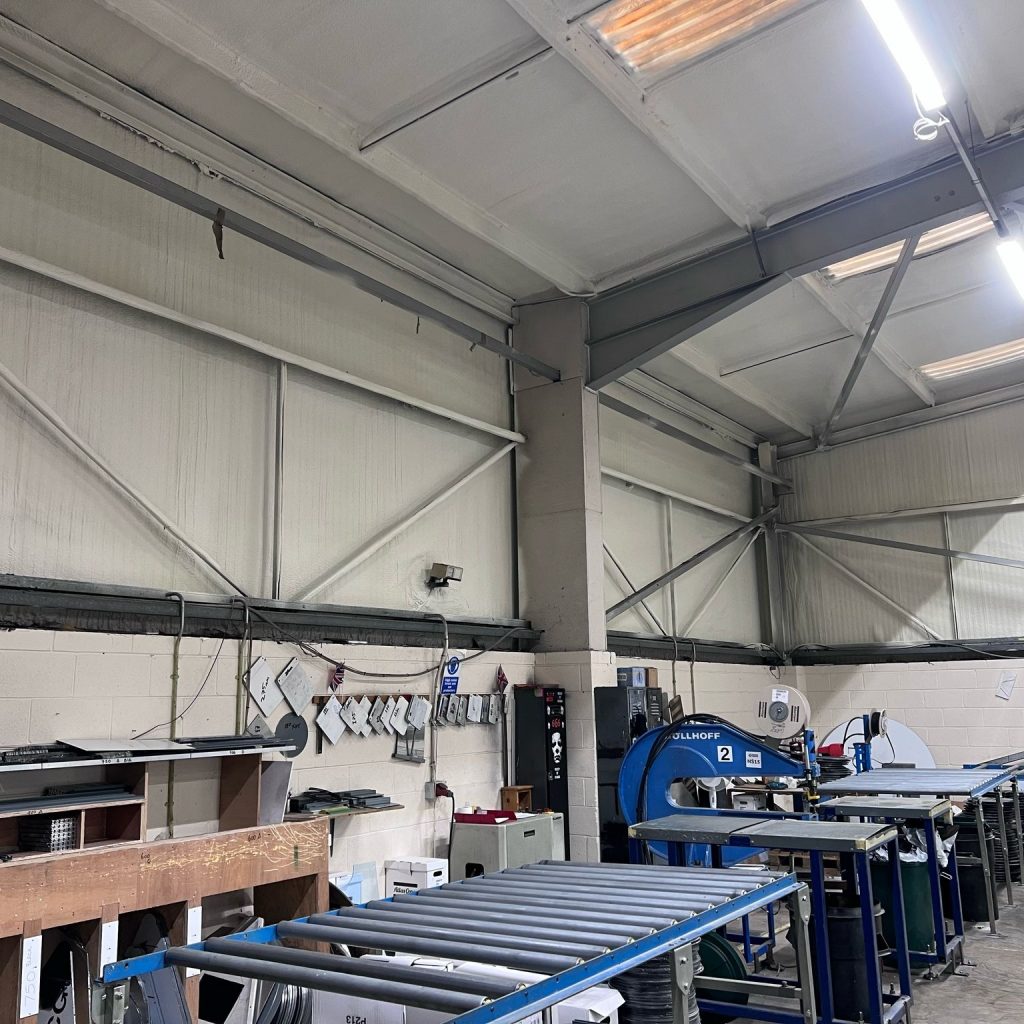
Nuneaton, England: workshop roof and walls insulated with the same Enverge system (UK project).
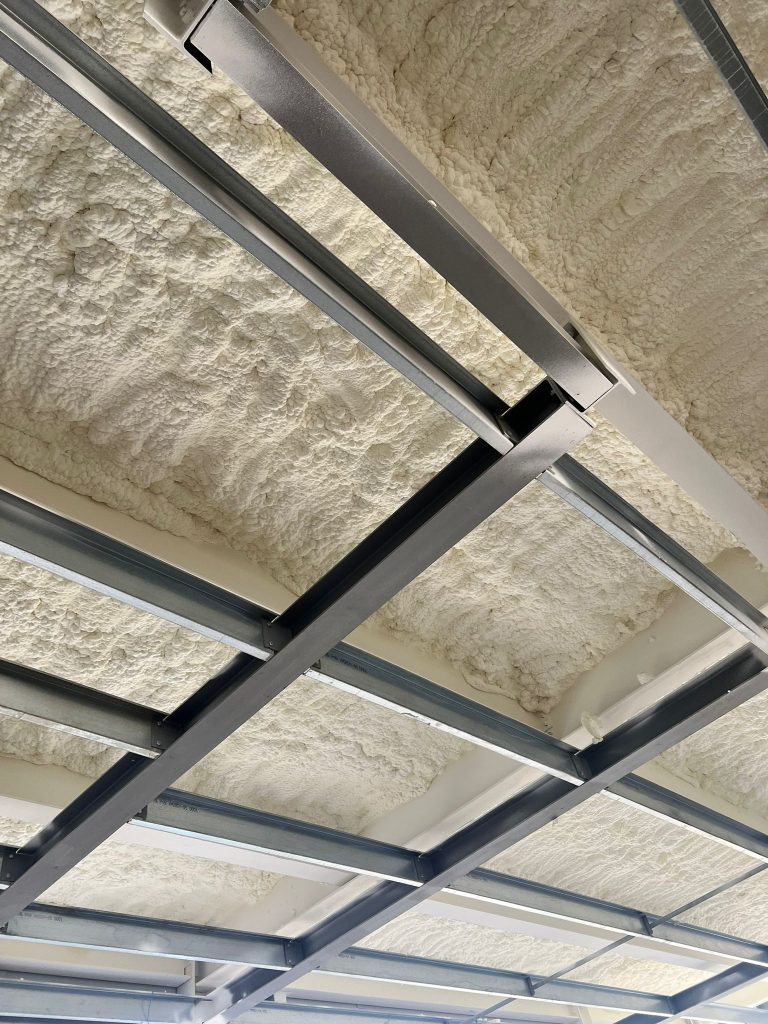
Closed-cell spray foam insulation to a steel deck soffit between structural beams.
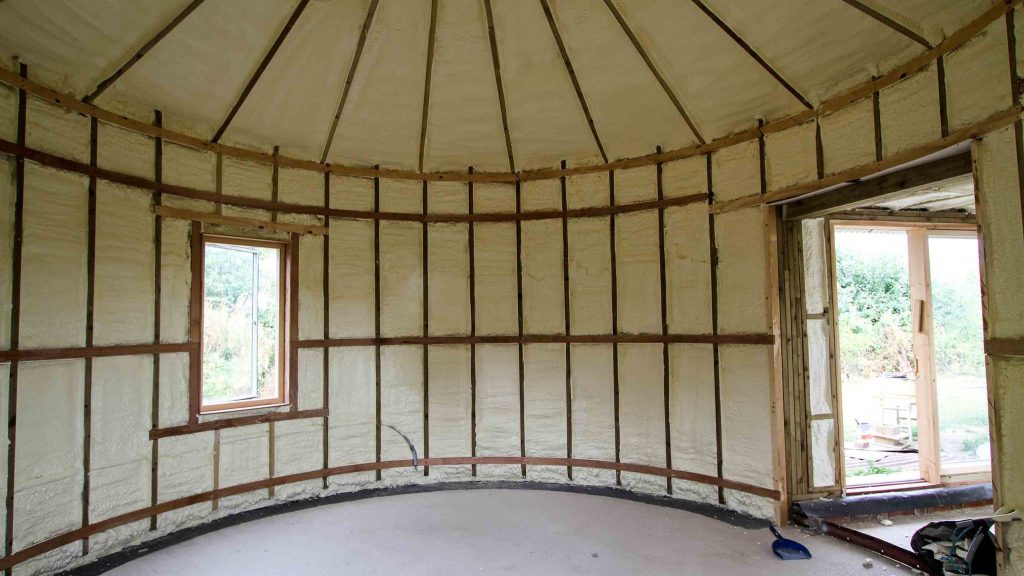
Steel-framed sheds, portal-frame warehouses and older commercial units. Spray foam bonds straight to roof sheets, walls and soffits, following every corrugation and fixing without boards, battens or overcladding.
More finished Duratite installations in the UK and Northern Ireland. Each caption says where the photo was taken.
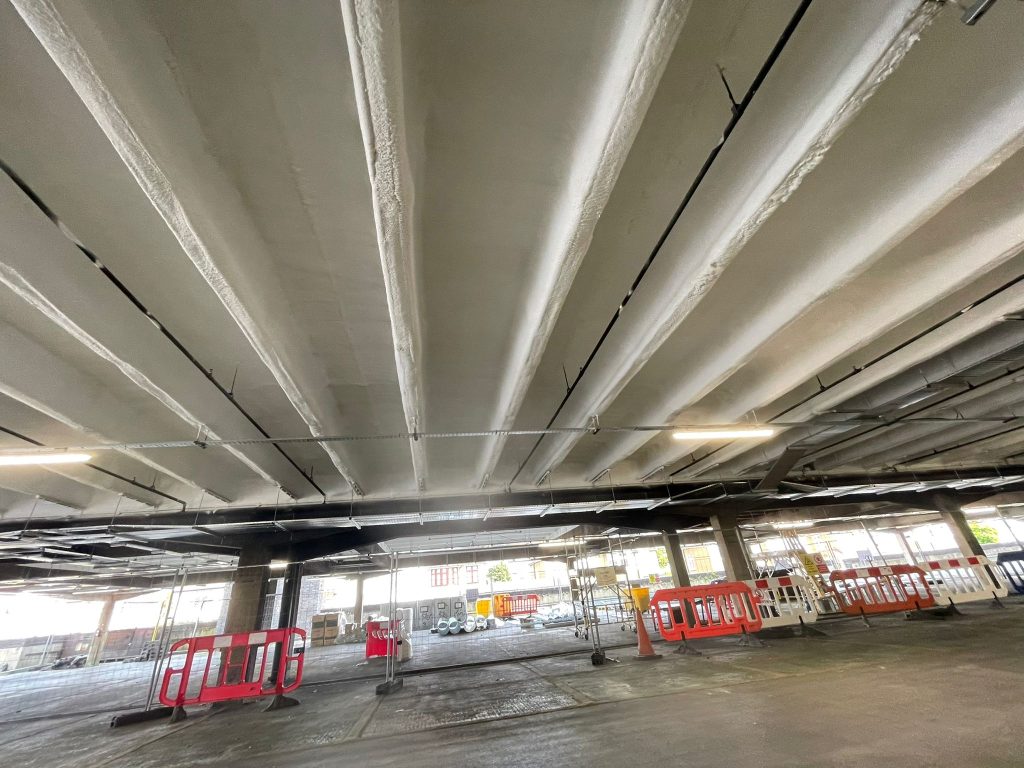
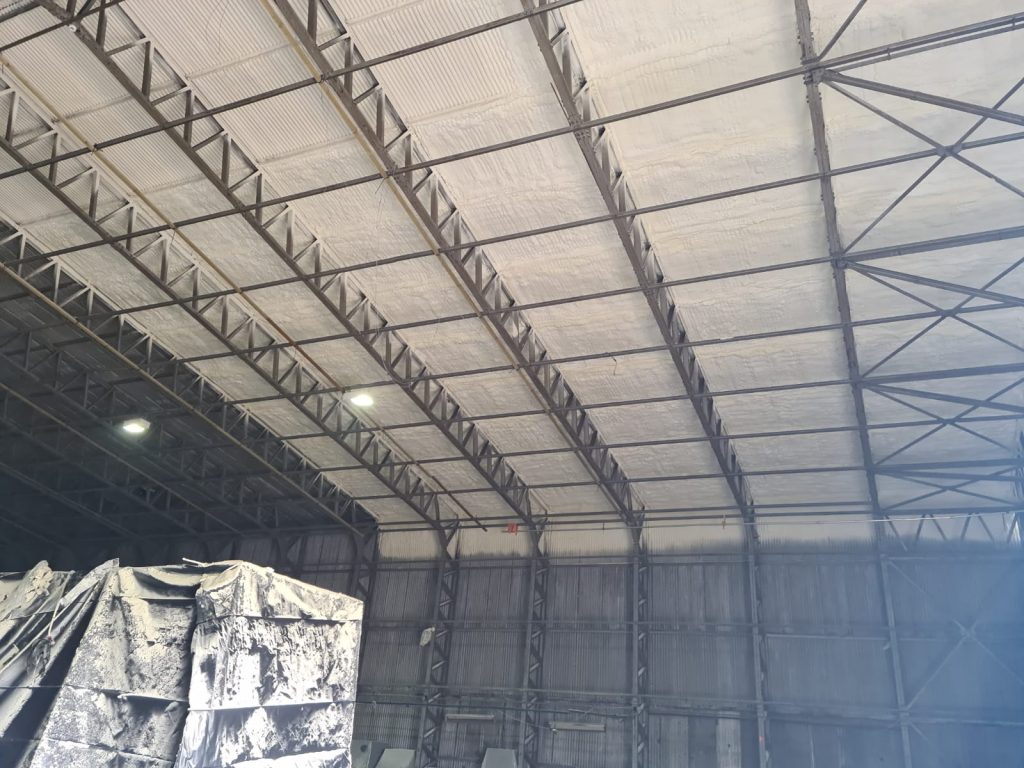
Spray foam applied across the soffit of a large open undercroft deck.
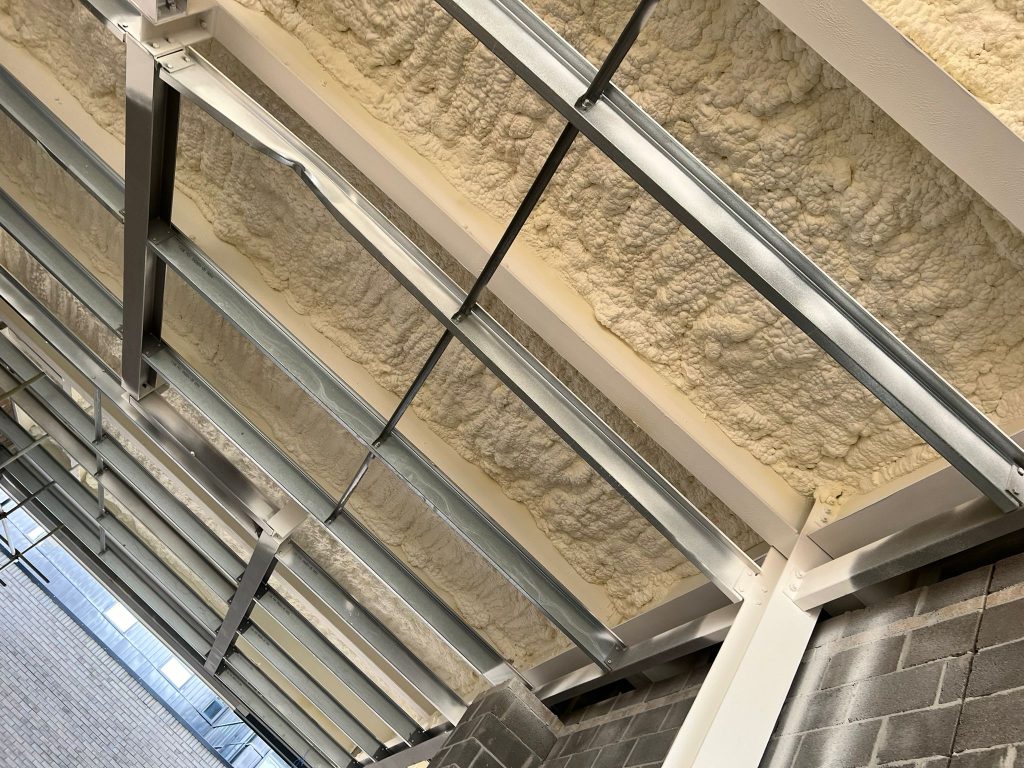
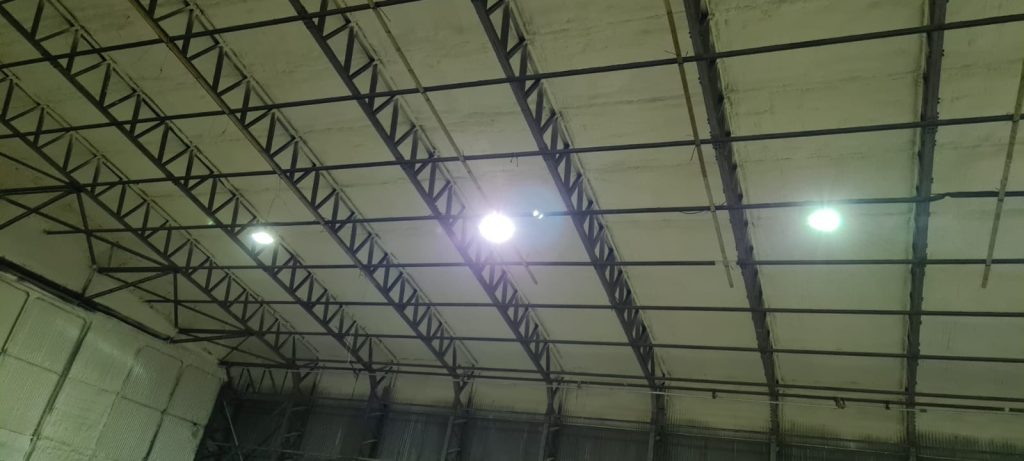
Closed-cell spray foam applied between the galvanised steel framing of a commercial roof soffit.
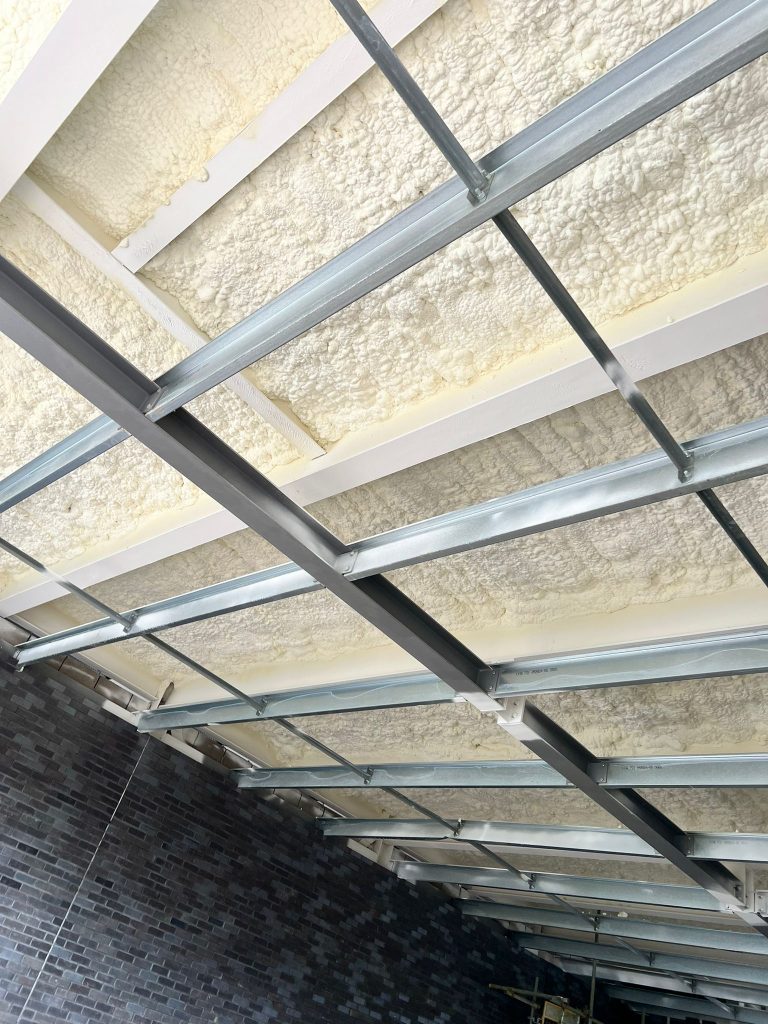
Completed spray foam soffit insulation between galvanised steel framing members.
Closed cell is the usual choice for metal roofs, agricultural buildings and anywhere vapour control matters. Open cell is breathable and suits internal walls, ceilings and roof voids. The installer confirms the product after surveying the building.
| System | What it is and where it suits |
|---|---|
| Enverge Nexseal LE — closed cell | A low-emission closed-cell foam for roofs, walls and soffits where vapour control and rigidity matter, including metal-clad agricultural and industrial buildings. |
| Enverge Sucraseal — open cell | An open-cell foam for internal applications where breathability and sound absorption are wanted. |
| Purios H — closed cell | Closed-cell foam with a declared thermal conductivity of 0.0224 W/m·K, made with a new-generation foaming agent with zero ODP and low GWP. CE marked with a published Declaration of Performance. |
| Purios F — open cell | Breathable open-cell foam with a declared λD of 0.036 W/m·K for internal walls, ceilings and roof voids. CE marked with a published Declaration of Performance. |
Approved installers cover County Dublin and the rest of Leinster.
A town or city in County Dublin, Leinster.
Quotations for Dublin are issued in euro.
Spray Foam Insulation pages for places near Dublin:
Somewhere else? We cover all 26 counties of the Republic of Ireland and all 6 counties of Northern Ireland.
Other systems surveyed and installed by approved installers:
Every enquiry starts with a free survey.
Straight answers to the questions Dublin building owners and managers ask most.
Yes. Duratite Ireland takes enquiries from Dublin and the wider County Dublin area and passes them to an approved spray foam installer who covers County Dublin. We do not run a branch office in Dublin; the survey and installation are carried out by the approved installer, with Duratite supplying the Enverge or Purios system.
Cost depends on area, access, substrate and the thickness needed, so we do not publish a price per square metre for Dublin. After the free survey you receive a written quotation in euro from the approved installer.
In most metal-clad buildings, yes. Condensation forms when warm, moist air meets the cold underside of the roof sheet. Closed-cell foam bonds to the sheet and keeps its inner face warm, so the surface stays above the dew point. The survey checks ventilation and moisture sources too, because very wet uses such as livestock housing need both.
Closed cell (Enverge Nexseal LE or Purios H) is the usual choice for metal roofs, agricultural buildings and anywhere vapour control matters. Open cell (Enverge Sucraseal or Purios F) is breathable and suits internal walls, ceilings and roof voids. The installer confirms the product after surveying the building.
Fire safety in the Republic of Ireland is covered by TGD B – Fire Safety, with material performance classified to I.S. EN 13501-1. Where foam would be left exposed in an occupied space, the specification includes the protection required, such as a thermal barrier or an intumescent coating like DC315.
Better fabric performance feeds into a building’s BER, which is required in the Republic of Ireland when a building is sold or let. The rating itself is issued by a registered BER assessor, so we cannot promise a particular grade.
In the Republic of Ireland it depends on whether the work is new build or a material alteration under TGD L 2022. For new buildings other than dwellings, Table 1 gives 0.16 W/m²K for pitched roofs, 0.20 for flat roofs and 0.21 for walls. For material alterations, Table 10 gives 0.25 for flat roofs and pitched roofs at the slope, and 0.35 for other walls.
An approved installer trained on the system being used. The manufacturer-backed product warranty depends on the system being installed to the manufacturer’s requirements, which is why Duratite Ireland only routes Dublin enquiries to approved installers.
Very likely, if it has an uninsulated steel roof. Condensation depends on how humid the air inside is and how cold the underside of the sheet gets, not on annual rainfall. Heated or busy units, forklift charging areas and loading bays with doors open to damp air all add moisture. Closed-cell foam on the underside of the sheeting removes the cold surface that moisture forms on.
Dublin City Council’s building control section is the authority within the city. The building owner and their designer are responsible for showing that the upgrade meets TGD L 2022 for buildings other than dwellings. The approved installer can supply product data, such as Nexseal LE’s 0.022 W/m·K thermal conductivity, so the designer can calculate the U-value for the finished roof or wall.
Often, in part. Spraying cannot happen above people or stock, so the installer normally works bay by bay, clearing and screening each area and ventilating it until it can be reoccupied in line with the manufacturer’s guidance. The programme is agreed with the site before work starts, so deliveries and dispatch can be moved around the zones being treated.
Drawings or a sketch plan, dated photos of drips or damp patches, and a short note on how each bay is used and heated. Say who controls the yard and loading docks if you share them, and whether the landlord must approve work. That lets the approved installer plan access and phasing, and flag repairs needed first.
Products, applications and every area we cover.
Read more → UK case studyThe same Enverge closed-cell system, sprayed in a working warehouse in England.
Read the case study → ServiceCommercial roof waterproofing, surveyed and installed by approved installers.
Read more → ServiceAsbestos cement roof encapsulation and waterproofing, surveyed and installed by approved installers.
Read more → CountyCoverage across the whole of County Dublin.
Read more → AreasEvery county in Ireland and Northern Ireland.
Read more →Tell us about the building and an approved installer covering County Dublin will be in touch.
Approved installers cover Spray Foam across Ireland and Northern Ireland. A few other locations near Dublin:
Tell us about your building and we’ll recommend the right system — foam, waterproofing or both — surveyed, specified and quoted at no cost.