
At a glance
- A silicone roof coating is a liquid, 100% silicone membrane applied over the existing roof. GacoFlex S42 is single-component, solvent-free and moisture-curing, and goes on by spray, brush or roller.
- It suits the Irish climate because silicone is UV-stable and resists ponding water, the water that sits on low-slope roofs after rain.
- S42 and SF42 do different jobs. S42 is the coating across the whole roof. SF42 is the fibre-reinforced grade for laps, fixings, penetrations and details. Its reinforcement is built in, so no separate fabric or mesh is needed.
- It goes over most commercial roofs: profiled metal, asbestos cement, aged felt and asphalt, concrete and aged single-ply, with the right preparation for each.
- A complete S42 system carries a 20-year manufacturer-backed product warranty when applied to specification. Every roof is priced after a free site survey.
What a silicone roof coating is
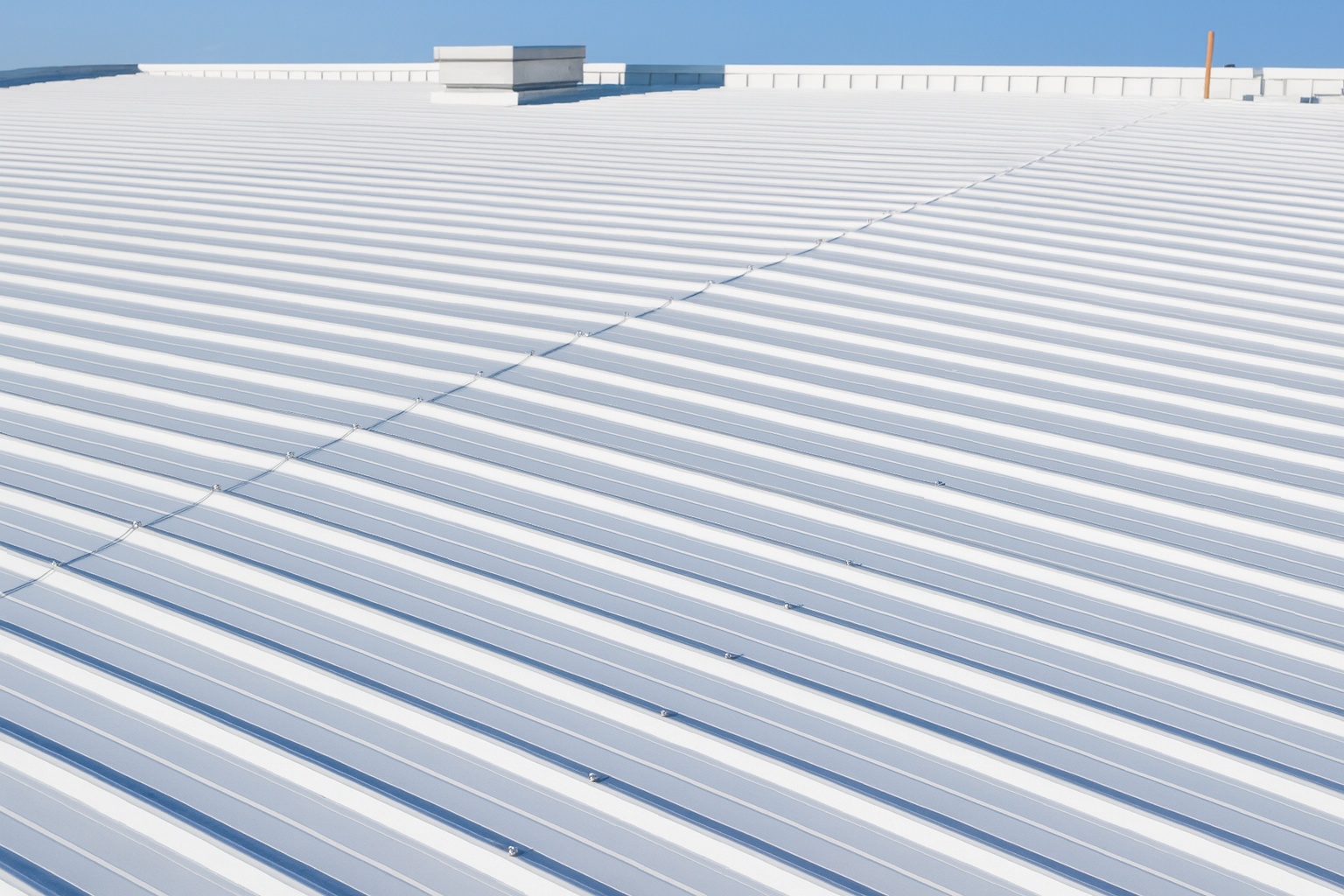
A silicone roof coating turns an existing roof into one continuous, seamless waterproof membrane without stripping it off. It goes on as a liquid, bonds to the prepared surface and cures in place, following every lap, fixing, corrugation and upstand.
GacoFlex S42, from Gaco by Amrize, is the silicone roof coating Duratite supplies in Ireland. The manufacturer's product data describes it as a 100% silicone, solvent-free, single-component coating that cures by reacting with moisture in the air. There is nothing to mix on the roof and no heat or flame, so it is a cold-applied process.
High solids, one coat
S42 is a high-solids coating. Almost everything that goes onto the roof stays there as the finished membrane, so the wet film the installer measures on the day is a reliable guide to what the roof ends up with. The S42 product data describes the warranty builds going on in a single coat. On site that means the specified film is built in one pass and checked with a wet-film gauge as the work moves across the roof.
What a silicone coating is not
- It is not spray foam. S42 and SF42 are silicone coatings. Spray foam insulation is a different product that goes on the underside of a roof, or under a coating as a roofing foam.
- It is not paint. A roof paint is a thin decorative film. A silicone roof coating is a waterproof membrane built to a specified thickness.
- It is not structural. A coating will not fix a rotten deck, a failed purlin or a sheet that has corroded right through. Those are repaired first, or the roof needs a different answer.
Why silicone suits Irish weather
Ireland's roofs deal with a lot of water. Met Éireann puts the national average annual rainfall at 1,288 mm for 1991–2020, and the pattern varies a great deal across the country:
| Area | Typical annual rainfall |
|---|---|
| Most of the eastern half of the country | 750–1,000 mm |
| The west | Generally 1,000–1,400 mm |
| Many mountainous districts | More than 2,000 mm |
| National average, 1991–2020 | 1,288 mm |
Source: Met Éireann, rainfall and 1991–2020 climate averages.
Ponding water
Flat and low-slope commercial roofs rarely drain perfectly. Deflection, blocked outlets and settled decks leave shallow pools after rain. Many coatings soften, lose adhesion or break down under standing water. The S42 product data describes it as ponding-water resistant, which is the main reason silicone is chosen for flat and low-slope roofs. Outlets and gutters still need to work. A coating protects the roof from ponding water. It does not replace drainage.
UV and weathering
Silicone is highly UV-stable. Rather than chalking and thinning under sunlight like many cheaper roof coatings, it holds its properties, which suits Irish roofs with long spells of changeable weather.
Application weather
Because S42 cures with moisture from the air, humidity is not its enemy the way it is for some coatings. The roof surface still has to be clean and dry when it is coated, and rain soon after application can mark a coating that has not cured. Approved installers plan around forecasts and work in sections that can be finished in a dry window.
GacoFlex S42 vs SF42: which does what
| GacoFlex S42 | GacoFlex SF42 | |
|---|---|---|
| What it is | 100% silicone roof coating | 100% silicone seam sealant |
| Fibre-reinforced? | No | Yes, reinforcement built in, no separate fabric or mesh |
| Where it goes | The whole roof surface | Laps and seams, fastener heads, penetrations, rooflight upstands, cracks and joints |
| How it goes on | Spray, brush or roller | Brush, trowel or spray |
| Role in the system | The waterproof membrane | Seals and reinforces the details before S42 goes over them |
Summary of the product data on the S42 and SF42 product pages.
On a commercial roof, most leaks start at the details rather than in the middle of a sheet. GacoFlex SF42 goes on those details first. Because it is the same silicone chemistry as S42, the top coat fuses into it as one membrane, with no joint between different materials to fail later. Gaco's 20-year manufacturer-backed product warranty applies to the complete S42 system, not to SF42 or S42 on their own.
For small repairs and flashing details, GacoPatch silicone sealant is the flashing-grade product in the same family. Where a urethane system suits a roof better, for example over closed-cell roofing foam, GacoFlex U91 base coat and U92 top coat are the alternative. See the GacoFlex U9 urethane series.
Not sure your roof can be coated?
Send a few photos and the building address. An approved installer will survey the roof and tell you plainly whether a silicone coating suits it.
Which roofs can take a silicone coating
| Roof type | Typical problems | Preparation before S42 |
|---|---|---|
| Profiled metal (box profile, trapezoidal, corrugated) | Cut-edge corrosion, leaking fixings, open side and end laps, rust | Clean, treat corrosion and cut edges, SF42 on laps and fixings, primer where the product data calls for one (for example some factory-finished panels) |
| Asbestos cement | Moss and lichen, cracked sheets, porous weathered surface, leaking laps | Cleaning method set by the plan of work, SF42 on cracks and laps, regulatory process first |
| Felt and asphalt | Blisters, splits, open seams, oils bleeding through in warm weather | Repair blisters and splits, GacoFlex A4271 Bleed Trap base coat to lock in bitumen oils |
| Concrete | Cracked screed, porous surface, failed joints | Repair cracks and joints, primer |
| Aged single-ply | Seam failures, shrinkage at edges | Clean, adhesion test, primer where needed |
General guide. The survey and an adhesion test confirm the preparation for each roof.
Metal roofs
Metal roofs usually fail at cut edges, fixings and laps long before the middle of the sheet. Corrosion is treated and the details are sealed with SF42 before the roof is coated. See cut-edge corrosion treatment. If the same roof drips condensation inside, read why metal roofs drip, because a coating on top does not stop condensation underneath.
Asbestos cement roofs
Coating an asbestos cement roof seals the sheets in place instead of stripping them. The work follows the asbestos regulations, which differ between the Republic and Northern Ireland and changed in the Republic in 2025. Read asbestos regulations in Ireland and see silicone coating for asbestos roofs.
Flat felt, asphalt and concrete roofs
Bitumen roofs bleed oils that can stain through a silicone finish, which is what the A4271 Bleed Trap base coat is for. Wet insulation trapped under an old felt roof has to be found and dealt with before any coating goes on. Our guide to commercial flat roof leaks covers how to tell, and flat roof waterproofing covers the options.
Adhesion test first: a small test patch on the actual roof confirms the preparation and whether a primer is needed. It takes a little time at the start and removes guesswork from the rest of the job.
Survey, clean, prime, coat: how the system goes on
- Free site survey. An approved installer checks the roof type and condition, leaks, drainage and ponding, rooflights, any asbestos, access and safety, then measures the roof and photographs the details. You receive a specification and a fixed quote.
- Repairs. Sheets that have corroded through, rotten or wet deck areas, broken rooflights and failed gutters are repaired or replaced first.
- Clean. The roof is cleaned so the silicone bonds to the roof and not to dirt or organic growth. GacoWash is Gaco's roof cleaning solution, and moss and lichen are treated where present. The roof then dries completely.
- Details. SF42 goes onto laps, seams, fixings, penetrations and upstands.
- Prime where needed. A4271 Bleed Trap on bitumen that bleeds oils, and a primer on concrete and the other substrates that need one.
- Coat. S42 goes over the whole roof to the specified film, and wet-film readings are taken and recorded as the work progresses.
- Handover. Readings, photographs and the product warranty documents go to the building owner.
Duratite supplies the system and technical support. The survey and the work are carried out by approved installers.
Coating vs overlay vs replacement
| Silicone coating | Overlay or overclad | Full replacement | |
|---|---|---|---|
| What happens | The existing roof is sealed in place | A new roof goes over the old one | The old roof is stripped and a new one built |
| Building in use? | Usually, with work above | Often, with fixings through the old roof | Usually disrupted, interior exposed |
| Hot works | None, cold-applied | Depends on the system | Depends on the system |
| Waste | Minimal | Some | A full roof, hazardous if asbestos |
| Structural check | Condition survey | Load check for the added roof | Full design |
| Adds insulation | No | Can | Can |
| Right when | The roof is sound but leaks at laps, fixings and details, or the membrane is tired | Insulation above the deck is wanted, or the covering is past coating | The structure or deck has failed, or the building is being rebuilt |
General comparison. The survey decides what suits your roof.
Insulation is the main thing a coating does not add. For a metal roof, closed-cell spray foam on the underside insulates and stops condensation while the coating waterproofs the top. Where roof work counts as a material alteration or works to a thermal element, TGD L 2022 Table 10 sets 0.25 W/m²K for a pitched roof insulated on the slope and for a flat roof. Your designer or assigned certifier confirms whether that applies. For a warehouse-specific comparison, see warehouse roof repair: coat, overclad or replace.
The 20-year manufacturer-backed product warranty
A complete GacoFlex S42 system carries a 20-year manufacturer-backed product warranty. It covers the system as a whole, not individual components, and depends on the job being done to the manufacturer's specification.
In practice that means:
- the survey confirms the roof is suitable for the system;
- the full system is used: clean, details in SF42, primer or Bleed Trap where needed, and S42 over the whole roof;
- the specified film build is achieved and the wet-film readings are recorded;
- the work is carried out by an approved installer, and photographs and readings go into the handover file.
Workmanship is covered separately by the installer who carries out the work. Keeping outlets and gutters clear and checking the roof after storms protects both.
Listings and fire performance
The S42 product data lists approvals including UL 790 Class A and a CRRC cool-roof rating listing. For a building in Ireland, your designer checks the external fire performance of the roof covering against TGD B in the Republic or Technical Booklet E in Northern Ireland.
Where we supply: Republic of Ireland and Northern Ireland
Duratite supplies GacoFlex S42 and SF42 across all of the Republic of Ireland and Northern Ireland, and passes survey requests to approved installers covering each county. We do not have branches in every town, and we do not pretend to.
The regulations differ on each side of the border:
- Republic of Ireland: TGD L for insulation, TGD B for fire, and the HSA for asbestos work.
- Northern Ireland: the Building Regulations (Northern Ireland) 2012 with Technical Booklets F2 and E, and HSENI for asbestos work.
See commercial roof waterproofing for all roof systems, or Gaco roof coatings for the full product range. Roof coating pages for individual areas are listed below.