
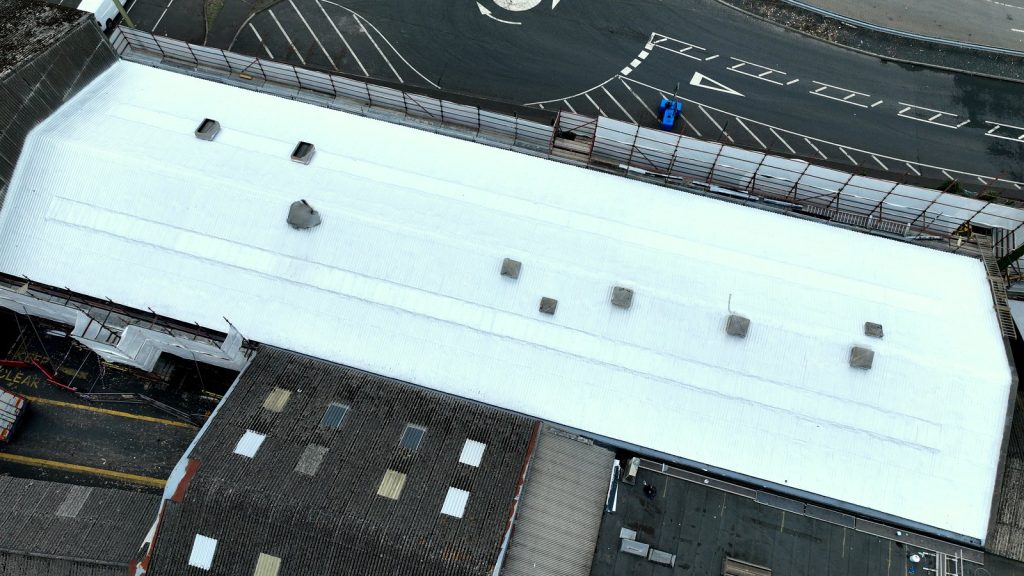
Encapsulated roof
Completed white coating on an asbestos cement roof at SAICA, Warrenpoint, County Down.
- Sheets left in place
- Northern Ireland project
Keep ageing asbestos cement roofs in County Fermanagh in place, sealed and watertight with the GacoFlex asbestos roof system. Removing an asbestos cement roof in County Fermanagh means specialist removal, disposal and a building without a roof until it is replaced. Where the sheets are still structurally sound, the GacoFlex asbestos roof system seals and waterproofs them in place instead.

Fermanagh is lake and upland country. Fermanagh and Omagh District Council, which covers the historic county together with Omagh, describes an area of lakelands, heather-clad mountains, ancient boglands and forest parks, including the Cuilcagh Lakelands Geopark. At 2,829 km² it is the largest of Northern Ireland’s 11 council areas, and it had 116,800 residents in Census 2021. Enniskillen, Lisnaskea, Irvinestown, Kesh and Newtownbutler are the county’s main towns, and farms are spread widely across the ground between the loughs.
It is also the wettest of the Northern Ireland stations in our verified data. The Met Office’s Lisnaskea Creamery station averaged about 1,064 mm of rain a year over 1991 to 2020, on around 179 wet days. That is roughly 240 mm more than Armagh, with rain on almost half the days of the year. Old asbestos cement roofs in that climate seldom get the chance to dry. Moss and lichen spread across the sheets, the cement surface wears away, and water sitting in laps and around fixings eventually finds a way through.
The farming reflects the ground. DAERA’s June 2025 census found 2,961 farms with a Co. Fermanagh address, averaging 36 hectares, and of 120,454 hectares farmed, 106,447 were grass with a further 10,241 in rough grazing. Beef cows outnumbered dairy cows by 35,404 to 24,159 within a cattle total of 152,847, and there were 115,967 sheep, while pig and poultry numbers were the lowest of the six counties. The buildings that count here are cattle houses, sheep sheds and fodder stores, which are full through the winter and cannot easily be emptied so a roof can be stripped.
Encapsulation lets those buildings stay in use. After surveying the sheets and the structure, the approved installer replaces broken sheets, cleans the roof without abrasion and seals it with Gaco urethane coatings, finished with a GacoFlex silicone topcoat where full waterproofing is specified. With so many wet days the programme needs slack: preparation can proceed between showers, while the coats themselves wait for a dry surface and conditions within Gaco’s published limits. On farms close to a lough shore, the installer also plans how washings from roof cleaning are collected instead of being left to run towards the water.
The Control of Asbestos Regulations (Northern Ireland) 2012 apply to this work and HSENI enforces them. The installer’s risk assessment and plan of work come before any access to the roof, which is made from boards and staging because the sheets are fragile. Fermanagh and Omagh District Council is the building control authority if insulation is added under the Building Regulations (Northern Ireland) 2012 and Technical Booklet F2. Duratite supplies the coatings and connects Fermanagh farmers with an approved installer, and the island-of-Ireland reference project is asbestos cement roof encapsulation at SAICA Warrenpoint, Co. Down.
It depends on roof area, condition, access and the specification, so we do not publish prices. After the free survey you receive a written quotation in sterling from the approved installer.
Older sheets lose their surface, grow moss and lichen and become porous. Encapsulation seals that weathered surface.
Asbestos cement sheets are fragile. The work is planned with safe access so no one relies on the sheets for support.
Hairline cracks, failed laps and fixings let water in. The coating system bridges and seals them across the whole roof.
Livestock sheds, stores and production buildings cannot easily be emptied for a roof replacement.
A Northern Ireland project, photographed on site. The SAICA Warrenpoint roofs combined closed-cell roofing foam with a GacoFlex U91 base coat; the build-up for each roof in County Fermanagh is set at survey.
Completed white coating on an asbestos cement roof at SAICA, Warrenpoint, County Down.
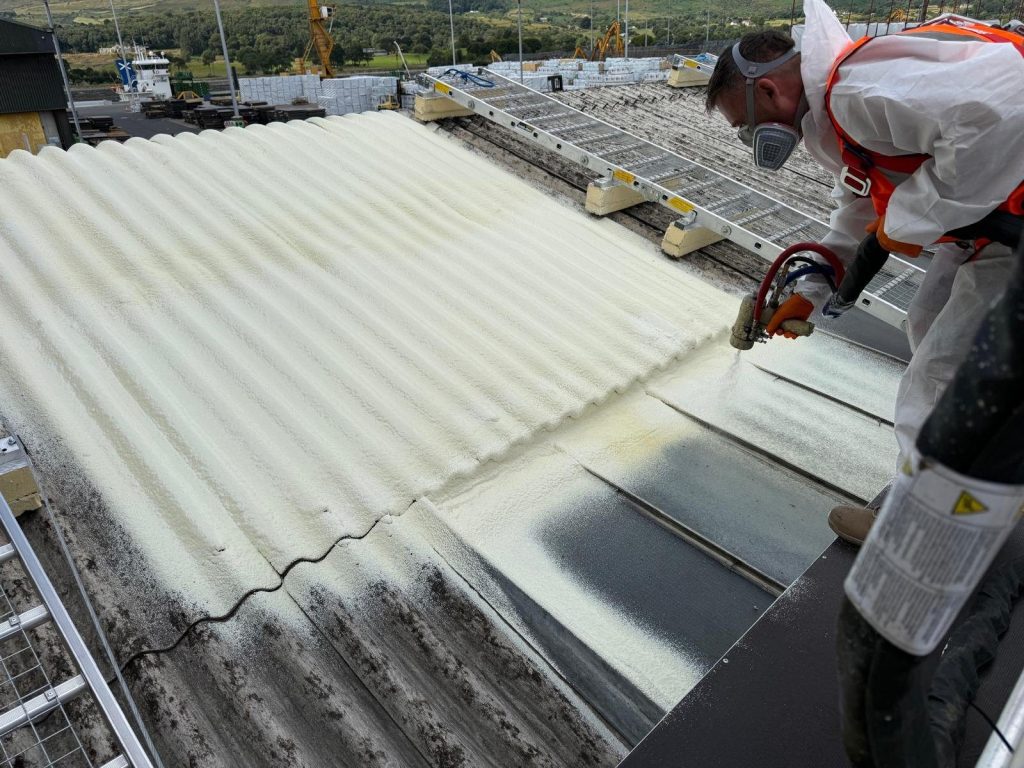
SAICA, Warrenpoint, County Down: closed-cell roofing foam spray-applied from the walkway system over asbestos cement (Northern Ireland project).
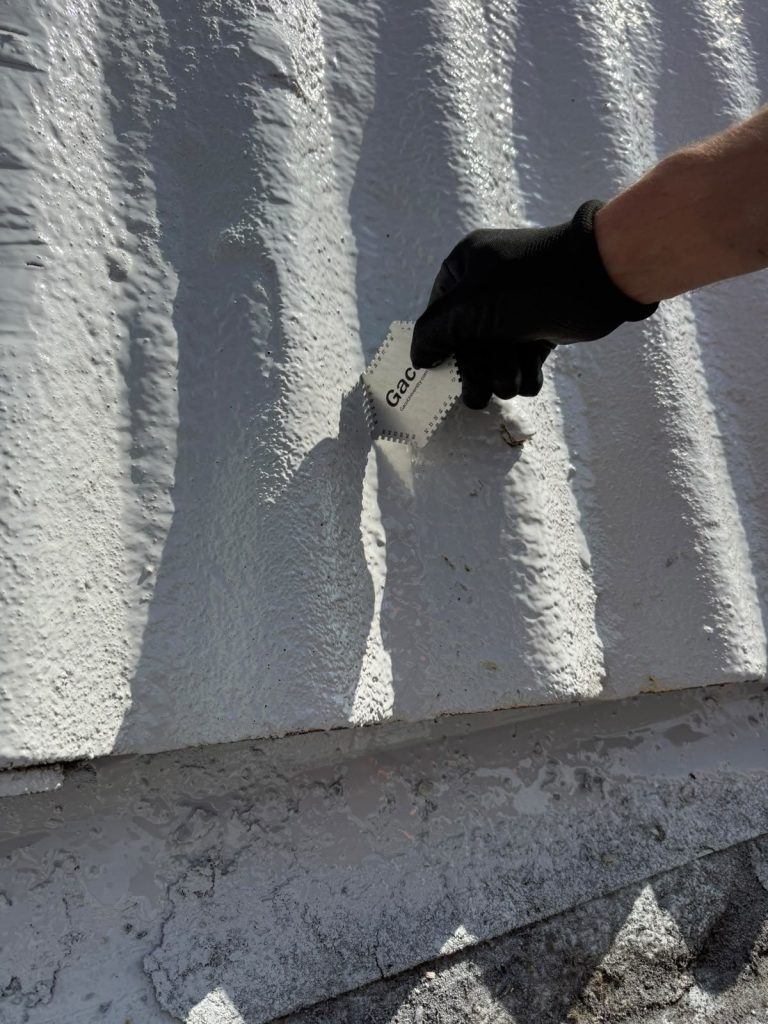
GacoFlex U91 base coat applied over the cured foam at SAICA, Warrenpoint.
Work with asbestos in Northern Ireland is governed by the Control of Asbestos Regulations (Northern Ireland) 2012, enforced by HSENI.
Every project is survey-led, with a risk assessment and plan of work prepared before the installer starts on your County Fermanagh roof.
Because the sheets stay in place, they remain part of the building’s asbestos records after the work in County Fermanagh.
Straight answers to the questions building owners and managers ask most often.
Yes. Duratite Ireland takes enquiries from County Fermanagh and routes them to an approved installer of the GacoFlex asbestos roof system who covers County Fermanagh. We do not have a branch office in County Fermanagh; the survey and application are carried out by the approved installer.
Allow for the survey, the specification, the risk assessment and plan of work, and any notification to HSENI that the work requires. The installer plans the programme around it.
No. Encapsulation seals the asbestos cement sheets and makes the roof watertight, but the sheets stay in place, so they remain part of the building’s asbestos records.
It depends on roof area, condition, access and the specification, so we do not publish prices. After the free survey you receive a written quotation in sterling from the approved installer.
In Northern Ireland, the Control of Asbestos Regulations (Northern Ireland) 2012, enforced by HSENI. Every project is survey-led, with a risk assessment and plan of work in place before work starts.
If the survey finds the sheets structurally sound, yes. The roof is prepared, sealed with GacoFlex U91 and U92 encapsulation coatings and, where specified, finished with a GacoFlex silicone topcoat. The sheets stay in place, so there is no removal or disposal.
Often, yes, because the work is carried out on the roof with the sheets left in place. The installer’s risk assessment sets out any restrictions for your building.
Yes, but it takes patience. The installer prepares the roof whenever it can and applies each coat only when the surface is dry and conditions are within Gaco’s limits. Booking with flexible dates, and letting the installer split the roof into sections, makes it far easier to finish.
Usually not for the whole job, since the sheets stay on and the work is done from above. The risk assessment decides whether any pens under a section being repaired need clearing for a time. If the stock go out to grass for part of the year, that can be a convenient window for the work.
The same regulations apply, but the installer takes extra care with water from cleaning the roof, collecting it rather than letting it run off towards the lough. Mention in your enquiry if a building is close to the shore.
The GacoFlex asbestos roof system, how encapsulation works and every area we cover.
Spray foam insulation, surveyed and installed by approved installers.
Commercial roof waterproofing, surveyed and installed by approved installers.
County · Republic of Ireland
County · Republic of Ireland
County · Republic of Ireland
County · Republic of Ireland
County · Northern Ireland
Town · County Donegal · Republic of Ireland
What the 2025 amendment means for roof owners, and the Northern Ireland rules.
Condition, management options and the rules that apply before any roof work starts.
Asbestos cement roofs encapsulated in place at an industrial plant in Warrenpoint, County Down.
Every county in Ireland and Northern Ireland.
Tell us about your building and we’ll recommend the right system — foam, waterproofing or both — surveyed, specified and quoted at no cost.