
Encapsulated roof
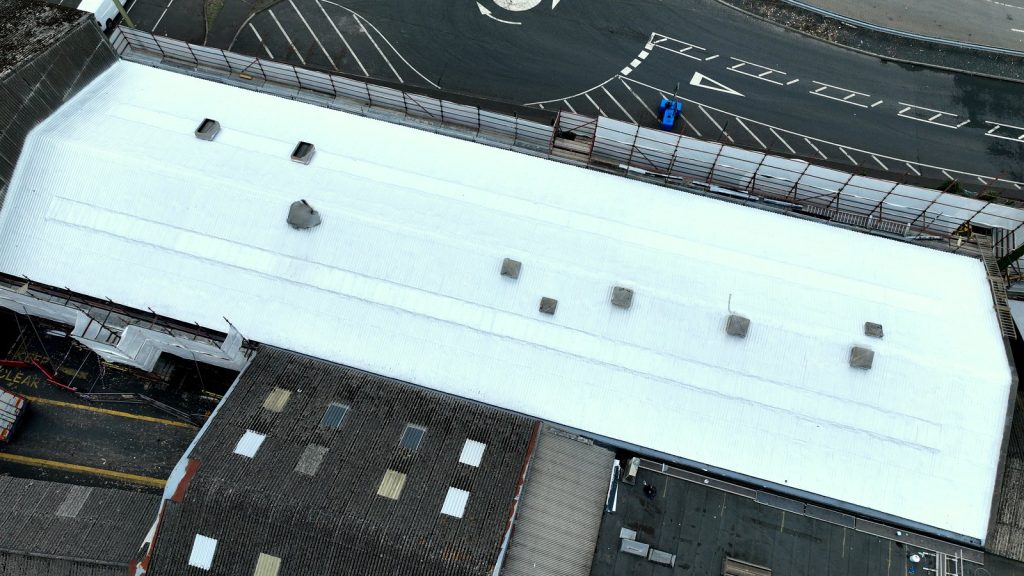
Completed white coating on an asbestos cement roof at SAICA, Warrenpoint, County Down.
- Sheets left in place
- Northern Ireland project
Encapsulate and waterproof asbestos cement roofs in County Antrim without removal — survey-led GacoFlex system applied by approved installers. Many farm buildings, factories and warehouses in County Antrim still have corrugated asbestos cement roofs. As the sheets weather they become brittle, porous and harder to keep watertight. Encapsulation seals the surface and waterproofs the roof while the sheets stay where they are.

County Antrim no longer exists as a council. Its farms and towns are split between Antrim and Newtownabbey Borough Council, Mid and East Antrim, Causeway Coast and Glens, and part of Lisburn and Castlereagh, so the first step on any roof project is to confirm which authority covers the address. Antrim and Newtownabbey alone had 145,700 residents in Census 2021. The county’s main towns include Antrim, Ballymena, Larne, Carrickfergus and Randalstown, and between them lies some of the most heavily stocked farmland in Northern Ireland.
DAERA’s June 2025 census recorded 4,567 farms with a County Antrim correspondence address, averaging 38 hectares and covering 218,023 hectares, the second-largest county total after Tyrone. The livestock figures are large: 332,198 cattle, including 73,226 dairy cows and 43,176 beef cows, 537,415 sheep and 47,255 pigs. Poultry stands out most, at 6,888,886 birds, the biggest county flock in Northern Ireland. Every one of those enterprises needs roofed space for animals, feed, bedding and machinery, and where any of those buildings still carry asbestos cement roofs, the sheets have been weathering for a long time.
The weather does the slow damage. The Met Office’s Aldergrove station recorded a 1991 to 2020 average of about 872 mm of rain on roughly 161 wet days. Rain that often keeps a roof damp for long periods. On asbestos cement it gradually opens up the surface, feeds moss and lichen, and loosens the seal around fixings, until water gets through at laps and ridges. A drip over a poultry house, a milking parlour or a bedding store causes trouble out of all proportion to the size of the crack.
Encapsulation treats the whole roof rather than one leak. The approved installer surveys the sheets and the purlins beneath, replaces any sheets that are broken, and removes growth by a method that does not grind or abrade the cement. Gaco urethane coatings, a U91 base coat and U92 top coat, then seal the surface, and a GacoFlex silicone topcoat can be added where full waterproofing is specified. Because the sheets stay put, housed birds or cattle do not have to be moved out for a strip-and-replace job, although the installer’s risk assessment may still ask for some areas to be cleared while particular sections are worked on.
In County Antrim, as across Northern Ireland, the Control of Asbestos Regulations (Northern Ireland) 2012 govern this work and HSENI enforces them. Access is planned around the fragility of the sheets, using crawling boards, staging and edge protection. Where the project also involves new insulation, the Building Regulations (Northern Ireland) 2012 and Technical Booklet F2 apply and the relevant council’s building control service needs to be involved. Duratite supplies the Gaco coatings and passes County Antrim enquiries to an approved installer; the island-of-Ireland reference project is asbestos cement roof encapsulation at SAICA Warrenpoint, Co. Down.
It depends on roof area, condition, access and the specification, so we do not publish prices. After the free survey you receive a written quotation in sterling from the approved installer.
Livestock sheds, stores and production buildings cannot easily be emptied for a roof replacement.
Removal needs specialist contractors, disposal and a replacement roof. Encapsulation leaves the sheets in place.
Older sheets lose their surface, grow moss and lichen and become porous. Encapsulation seals that weathered surface.
Asbestos cement sheets are fragile. The work is planned with safe access so no one relies on the sheets for support.
A Northern Ireland project, photographed on site. The SAICA Warrenpoint roofs combined closed-cell roofing foam with a GacoFlex U91 base coat; the build-up for each roof in County Antrim is set at survey.
Completed white coating on an asbestos cement roof at SAICA, Warrenpoint, County Down.
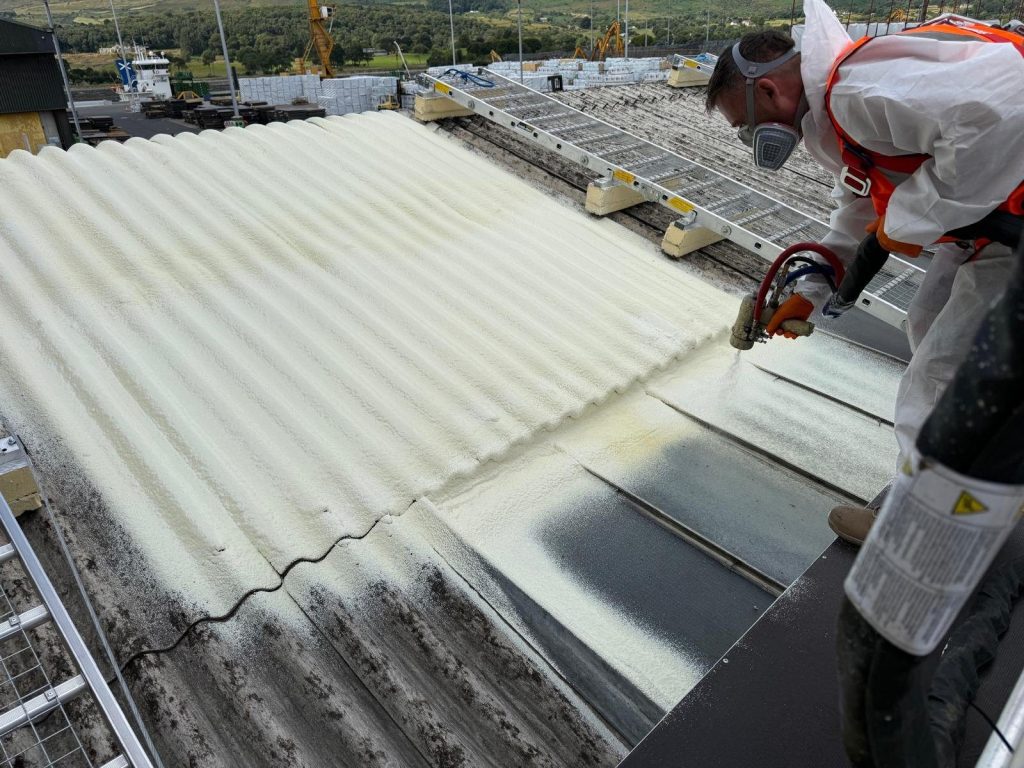
SAICA, Warrenpoint, County Down: closed-cell roofing foam spray-applied from the walkway system over asbestos cement (Northern Ireland project).
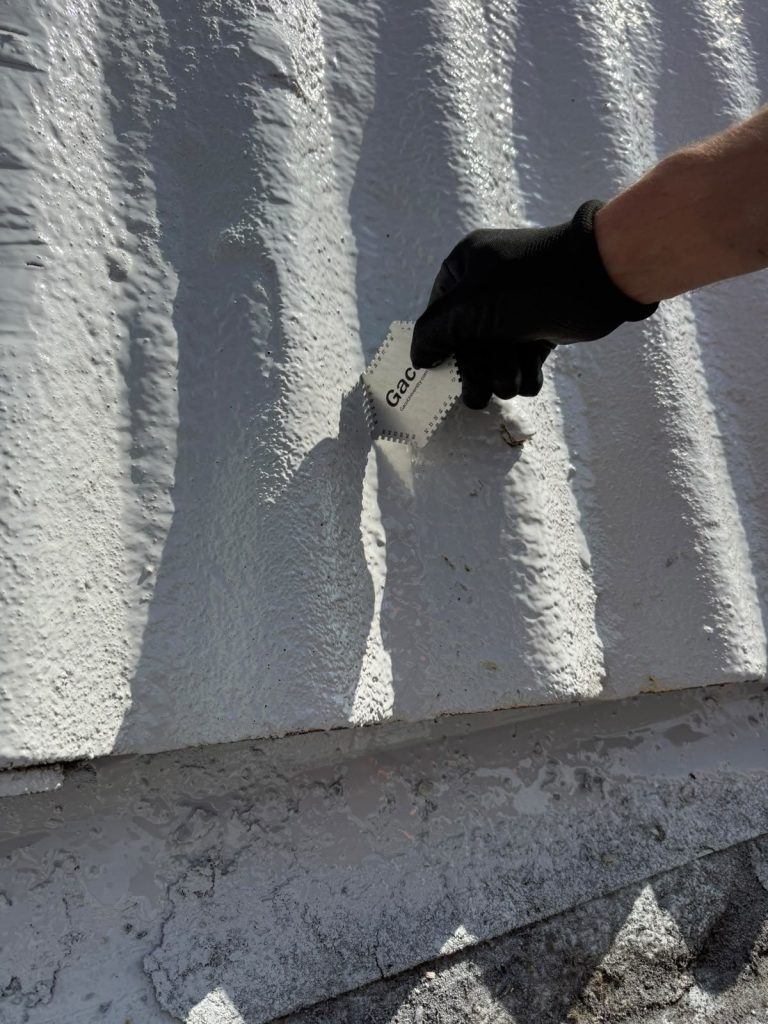
GacoFlex U91 base coat applied over the cured foam at SAICA, Warrenpoint.
Work with asbestos in Northern Ireland is governed by the Control of Asbestos Regulations (Northern Ireland) 2012, enforced by HSENI.
Every project is survey-led, with a risk assessment and plan of work prepared before the installer starts on your County Antrim roof.
Because the sheets stay in place, they remain part of the building’s asbestos records after the work in County Antrim.
Straight answers to the questions building owners and managers ask most often.
Yes. Duratite Ireland takes enquiries from County Antrim and routes them to an approved installer of the GacoFlex asbestos roof system who covers County Antrim. We do not have a branch office in County Antrim; the survey and application are carried out by the approved installer.
It depends on roof area, condition, access and the specification, so we do not publish prices. After the free survey you receive a written quotation in sterling from the approved installer.
In Northern Ireland, the Control of Asbestos Regulations (Northern Ireland) 2012, enforced by HSENI. Every project is survey-led, with a risk assessment and plan of work in place before work starts.
If the survey finds the sheets structurally sound, yes. The roof is prepared, sealed with GacoFlex U91 and U92 encapsulation coatings and, where specified, finished with a GacoFlex silicone topcoat. The sheets stay in place, so there is no removal or disposal.
Often, yes, because the work is carried out on the roof with the sheets left in place. The installer’s risk assessment sets out any restrictions for your building.
Allow for the survey, the specification, the risk assessment and plan of work, and any notification to HSENI that the work requires. The installer plans the programme around it.
No. Encapsulation seals the asbestos cement sheets and makes the roof watertight, but the sheets stay in place, so they remain part of the building’s asbestos records.
Not usually for the whole job, because the sheets stay in place and the coating goes on from above. The approved installer’s risk assessment identifies any sections where the space beneath must be cleared, such as where a broken sheet is replaced, and the programme can be timed around flock changeovers if that suits the farm.
County Antrim is split between several councils: Antrim and Newtownabbey, Mid and East Antrim, Causeway Coast and Glens, and part of Lisburn and Castlereagh. Building control sits with whichever one covers the address. The asbestos regulations and HSENI are the same across all of them.
Aldergrove records rain on about 161 days a year, so the installer plans for interruptions. Preparation and sheet replacement can go ahead in mixed weather, but coating waits for a dry roof and conditions within Gaco’s limits, and a large roof may be finished in stages.
The GacoFlex asbestos roof system, how encapsulation works and every area we cover.
Spray foam insulation, surveyed and installed by approved installers.
Commercial roof waterproofing, surveyed and installed by approved installers.
County · Northern Ireland
County · Northern Ireland
County · Northern Ireland
County · Northern Ireland
Town · County Armagh · Northern Ireland
Town · County Londonderry · Northern Ireland
What the 2025 amendment means for roof owners, and the Northern Ireland rules.
Condition, management options and the rules that apply before any roof work starts.
Asbestos cement roofs encapsulated in place at an industrial plant in Warrenpoint, County Down.
Every county in Ireland and Northern Ireland.
Tell us about your building and we’ll recommend the right system — foam, waterproofing or both — surveyed, specified and quoted at no cost.