Home›Corrugated Roof Insulation
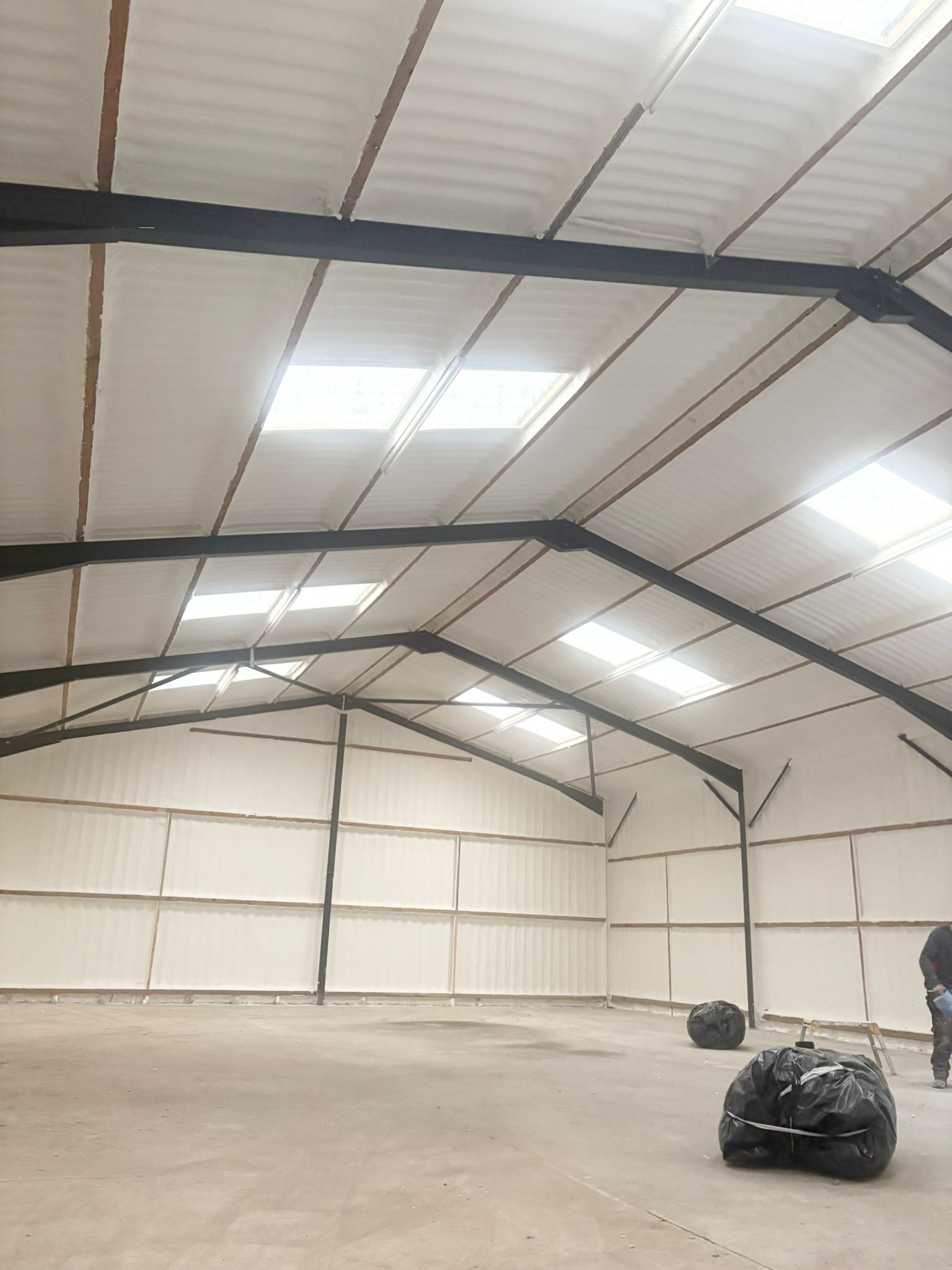
Spray foam that bonds directly to corrugated metal, box profile, cement fibre and asbestos sheets — eliminating condensation and transforming thermal performance. Applied to the underside, Nexseal LE follows every ridge and trough of the profile perfectly, creating a continuous insulated layer that rigid boards simply cannot achieve.

Nexseal LE is a closed-cell spray polyurethane foam — performance declared to I.S. EN 14315-1 — that bonds directly to metal, cement fibre and asbestos sheeting. Applied to the underside of corrugated roofing, it follows every ridge and trough of the profile perfectly — creating a continuous insulated layer that rigid boards simply cannot achieve. With a lambda value of 0.027 W/m·K, even thin applications deliver outstanding thermal performance.
Why corrugated roofs are condensation factories: single-skin corrugated roofing — whether metal, cement fibre or asbestos — has no thermal break. The thin sheeting conducts heat rapidly, creating a massive temperature differential between the warm interior and the cold roof surface. In cold weather, warm moist air rises and condenses instantly on contact with the sheeting.
The corrugated profile makes this worse. Condensation does not drip evenly — it channels along the troughs and drips in concentrated lines, creating persistent drip paths directly onto stock, equipment and surfaces below. Traditional solutions like drip trays and anti-condensation fleece only manage the symptom, not the cause.

Whatever the profile type, spray foam follows the contours perfectly. Rigid insulation boards cannot do this — the corrugated shape makes board insulation impractical on every profile listed below.
The most common commercial roof sheeting. Boards cannot follow the angular transitions — foam bonds to every face, angle and fixing for a seamless insulated layer.
Traditional wave-form sheets on agricultural buildings, workshops and older industrial units. Nothing flat can follow a curved surface — foam fills every trough and bonds to every crest.
Modern non-asbestos profiled sheets — porous and prone to moisture ingress. Foam seals the underside completely, blocking moisture paths while adding insulation. Two problems solved in one.
Foam encapsulates the asbestos roof surface from the underside without disturbing fibres — sealing, insulating and stopping condensation without a licensed removal project.
Foam bonds to the flat panels between seams and fills around the seam profiles — without interfering with the concealed fixing system or thermal movement joints.
Panels that have lost performance through age or delamination can be upgraded from the underside — a cost-effective thermal upgrade that avoids full re-roofing.
Single-skin corrugated roofs are condensation factories. Warm moist air rises, hits cold metal, and water pours down the troughs in concentrated drip lines. Here is how Nexseal LE solves every aspect of the problem.
Corrugated profiles channel condensation into concentrated drip lines along every trough. Foam raises the metal temperature above the dew point, stopping condensation forming in the first place.
Water collects at purlin connections, lap joints and fixing points. Foam seals around every obstruction, eliminating the cold spots where condensation pools and drips.
Persistent condensation corrodes metal roofing from the underside — invisible until it is too late. Foam seals the metal surface from moisture, protecting roof life.
Condensation dripping onto machinery, stock, vehicles and materials causes thousands of pounds of damage annually. Eliminating the condensation eliminates the damage.
Uninsulated corrugated roofs haemorrhage heat in winter and bake the interior in summer. Spray foam dramatically reduces energy costs in both seasons.
Closed-cell foam laminated to the underside measurably increases panel stiffness — reducing oil-canning, wind noise and flexing on older, thinner sheets.
No other insulation method can follow the corrugated profile, seal around fixings, provide a vapour barrier and add structural rigidity — all in a single application. Foam expands into every ridge, trough, angle and curve: zero gaps, zero cold bridges, zero compromise.
It bonds chemically to the roofing sheets — no screws, clips, battens or adhesives, and no penetrations through the roof that could leak or corrode. On asbestos cement roofs, it encapsulates the surface without disturbing fibres, avoiding the cost and disruption of licensed removal.
See how Nexseal LE closed-cell spray foam compares to the traditional approaches used on corrugated roofing.
| Property | Nexseal LE Spray Foam | Traditional (Board Between Purlins / Drip Trays / Fleece) |
|---|---|---|
| Condensation Control | Eliminated at source — integral vapour barrier | Fleece absorbs then drips; trays only catch water |
| Coverage Around Purlins/Fixings | Wraps around every purlin and fixing seamlessly | Boards stop at purlins — cold bridges at every connection |
| Vapour Barrier | Integral — closed-cell structure | Separate membrane required — often poorly fitted |
| Thermal Bridging | None — continuous coverage | Major — at every purlin, bolt and overlap |
| Speed of Install | Large areas covered in hours | Days or weeks of cutting and fitting |
| Structural Benefit | Adds rigidity to sheeting | No structural contribution |
| Asbestos Compatibility | Encapsulates without disturbing fibres | Requires removal or leaves asbestos exposed |
| Maintenance | None — maintenance-free for life | Fleece degrades; trays need emptying and replacing |
| Longevity | Lifetime of building — no degradation | Fleece: 5–10 years; boards: sag and degrade |
Four steps get your corrugated roof insulated quickly and professionally — the building can often remain operational during application.
We survey the roof — profile type, sheeting condition, purlin spacing, building use and access. For asbestos roofs, a management survey confirms the material. This determines the correct specification.
We specify the Nexseal LE thickness based on profile type, target U-value and building use. A detailed fixed-price quotation covers all preparation, application and clean-up.
Trained applicators spray Nexseal LE directly to the underside of the roofing sheets. Foam follows every ridge, trough, purlin and fixing. The building can often remain operational.
You receive a completion pack with thickness verification photographs, product datasheets and warranty documentation. The building is left clean with dramatically improved thermal performance.
Completed by our approved installer network across Ireland and Northern Ireland.

Severe condensation was dripping onto stock. The box profile steel roof was sprayed with 50mm Nexseal LE across the entire area. Condensation eliminated completely — no more drip damage, and heating costs reduced significantly.

A livestock building with a sinusoidal corrugated metal roof. Condensation was causing health issues for animals and corroding internal steelwork. Sprayed with 35mm Nexseal LE — condensation gone, animals healthier, structure protected.

A manufacturing unit losing heat rapidly and dripping condensation onto production equipment. 60mm Nexseal LE applied to the entire roof — energy costs dropped dramatically and the condensation problem was solved permanently.
Nexseal LE closed-cell spray foam bonded to corrugated roofing profiles — following every ridge and trough.




As an authorised distributor of Enverge spray foam systems, Duratite supplies the products and technical backing; installation is carried out by our network of trained, approved applicators.
Factory-direct supply of Nexseal LE with full manufacturer backing, technical support and warranty coverage.
Every installer in our network is factory-trained on Enverge equipment and holds current spray foam qualifications.
No surprises. Every project is surveyed and quoted at a fixed price before any work begins. Free surveys across Ireland and Northern Ireland.
Nexseal LE performance is declared to I.S. EN 14315-1 — backed by a 25-year manufacturer product warranty.
Duratite has delivered spray foam insulation since 2015 across commercial, industrial, agricultural and residential applications.
We insulate corrugated roofs on warehouses, factories, agricultural buildings and industrial units across Ireland and Northern Ireland.
Independently certified products — tested to published standards. Full project packs supplied on request — email info@duratite.ie.
Common questions about spray foam insulation for corrugated, box profile and metal roofs.
Large-scale commercial warehouse and industrial unit insulation — cut energy costs and stop condensation.
Learn more →AviationLarge-scale thermal insulation for aircraft hangars and large steel structures.
Learn more →AgricultureFarm buildings, barns and livestock buildings insulated with spray foam.
Learn more →ContainersAnti-condensation protection and full container conversions — eliminate condensation rain.
Learn more →Curved SteelSpray foam bonds directly to curved steel surfaces.
Learn more →HubExplore all commercial spray foam insulation applications, systems and sectors.
Learn more →Book a free roof survey or request a callback from our corrugated roof insulation team. We work on warehouses, factories, agricultural buildings and industrial units across Ireland and Northern Ireland.
Fixed-price quotation covering preparation, application and clean-up — no hidden extras.
Mon–Fri 8am–5pm · info@duratite.ie
Real Duratite projects — building type, location, system used and the outcome on site.
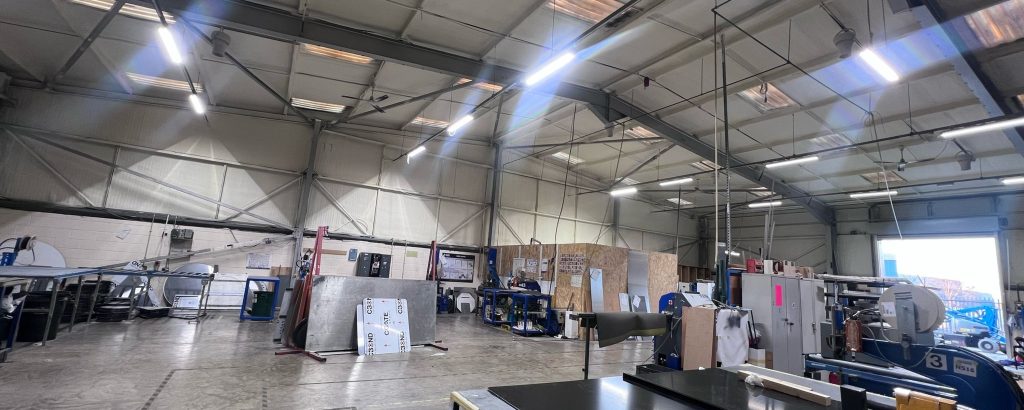 Nuneaton, EnglandIndustrial Warehouse
 Alton, Hampshire, EnglandAircraft Hangar
Tell us about your building and we’ll recommend the right system — foam, waterproofing or both — surveyed, specified and quoted at no cost.
Large-scale thermal insulation for aircraft hangars.
Spray foam bonds directly to curved steel surfaces.
Cut energy costs and stop condensation in warehouses.
Eliminate condensation rain inside shipping containers.
Seamless spray foam membrane for flat roof applications.
Explore all commercial spray foam insulation applications.