
Asbestos Roof Encapsulation – Dove Lane, Bristol
From failing roof to finished system


The Challenge
Asbestos cement roof sheets are stable while their surface is intact. The cement binds the fibres, and an undamaged sheet releases nothing. The problem is what four decades of wind, rain and frost do to that surface.
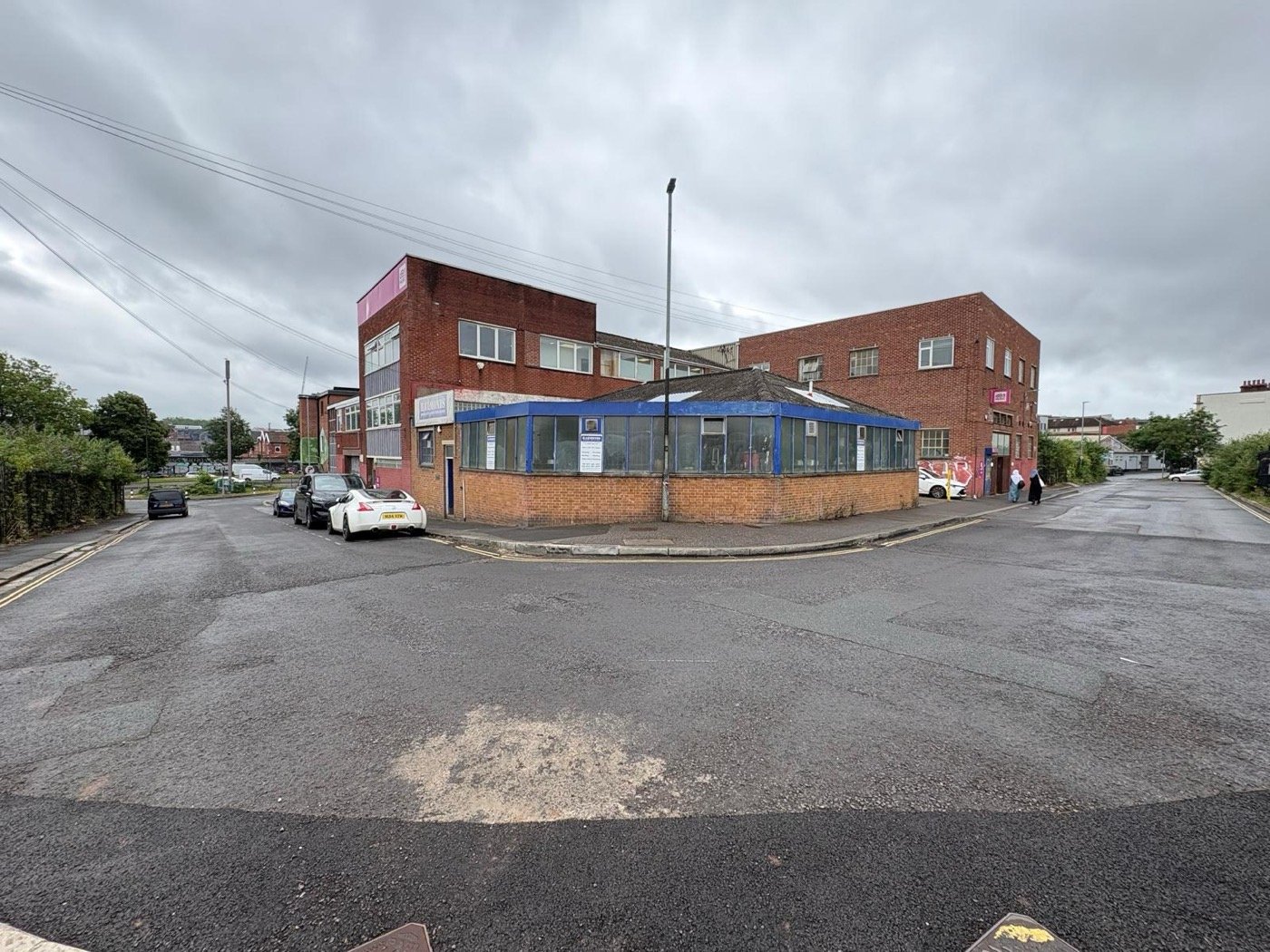
At Dove Lane the pitch had been colonised end to end. Moss and lichen had rooted down into the corrugation troughs, and once established they hold water against the cement permanently rather than letting it run off. That standing moisture works into the surface, and the freeze–thaw cycle does the rest — opening the matrix a little further each winter.
Fixings had corroded. Vegetation had taken hold along the gutter line. The adjoining bitumen flat roof had reached the end of its own service life alongside it.
None of this had compromised the structure. The sheets were sound and the building was watertight enough to trade from. What had degraded was the surface — and on an asbestos roof, the surface is the containment.

Project file

Book a free survey and we’ll come back with a fixed price for your own roof.
The Solution — step by step
Why not simply remove it?
Stripping the roof is the instinctive answer, and on a badly damaged roof it is the right one. Here it was not proportionate. Removal would have meant a licensed contractor, controlled disposal of every sheet, full scaffold and edge protection, and a working building handed over to the programme for its duration — all to replace sheets that were still doing their job.
Encapsulation inverts the logic. Rather than breaking the material up in order to carry it away, it seals the material where it stands. The fibres stay bound, nothing enters the waste stream, and the building keeps working throughout.
The system
Four layers, applied externally, each doing one job. No layer is decorative and none can be left out — the foam without the membrane has no weather protection, and the membrane without the top coat has no UV protection.
- Sollac Hipolava — biocidal clean. A full biocidal wash to kill the moss, lichen and algae and take the roof back to a sound, dry substrate. This is the step that decides whether the rest of the system lasts twenty years or two — nothing bonds reliably to a living surface, and organic growth left in place simply carries on growing underneath.
- Purios HR closed-cell roofing foam — 25 mm. Spray-applied across both roofs, self-bonding to the corrugated profile with no mechanical fixings — which matters here, because a fixing means penetrating the very material being contained. The foam follows every contour, encapsulating the sheets and splinting them at the same time.
- Impermax R3000 ST — liquid membrane. A single-component polyurethane membrane applied over the cured foam, forming a seamless waterproof surface with no laps, welds or joints to fail. Applied in two differently coloured coats so that full coverage is visible rather than assumed.
- Colodur top coat — aliphatic, grey. An aliphatic polyurethane finish, pigmented on site. Aliphatic chemistry is what makes it UV-stable: it shields the membrane beneath from sunlight rather than degrading in it, and gives the roof its finished grey appearance.
Purios HR — technical data
- Thermal conductivity (λ): 0.0233 W/mK
- Density in finished product: min 50 kg/m³
- Closed-cell content: min 90%
- Compressive strength at 10% strain: ≥300 kPa
- Water vapour resistance factor (μ): ≥54
- Water absorption: ≤0.14 kg/m²
- Applied layer thickness: 10–20 mm per pass, to EN 14315-1:2013
The installation
Carried out externally by Duratite approved installer McKee Insulations Limited, working off the roof itself — no full scaffold, and no internal works.
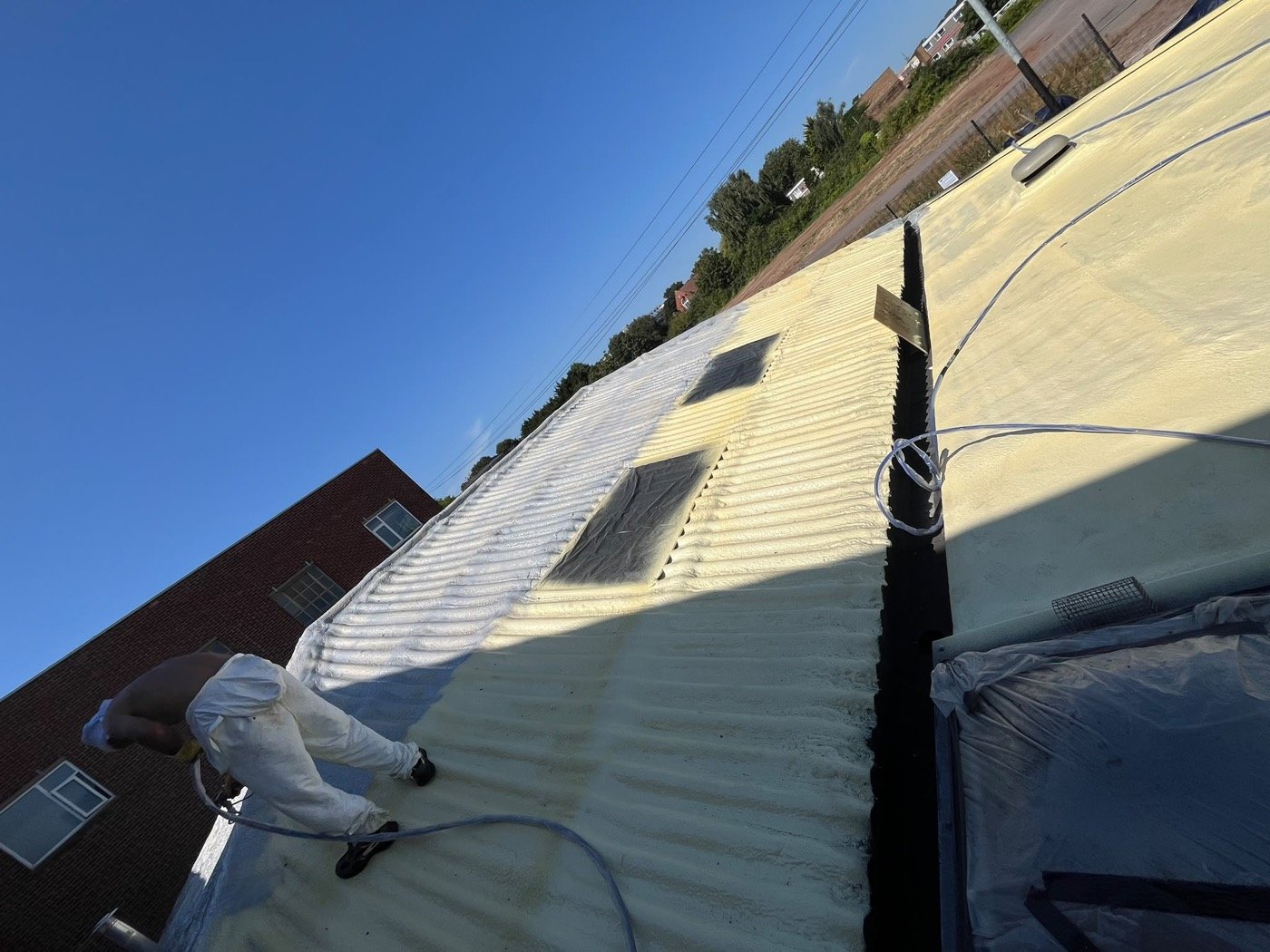
The flat roof was treated as part of the same surface rather than as a separate system, so the two roofs were sequenced together and the junction between them was bridged by the same continuous build-up rather than detailed as a joint. Rooflights, vents and roof penetrations were masked before spraying and cut back afterwards, which is why they read as clean openings in the finished roof rather than as coated-over lumps.
The foam was applied in passes of 10–20 mm to a 25 mm finished build. Spraying to a set thickness on a corrugated profile means working to the crown, not the trough — the trough inevitably carries more material, which is what gives the finished roof its even profile. Once cured, the Impermax membrane went on in two coats and the Colodur top coat followed, taking the roof from bare cream foam to the finished grey surface.
Working to the weather
Closed-cell foam is unforgiving about conditions. Purios HR requires a substrate and ambient temperature of at least 15 °C and relative humidity no higher than 60%, on a substrate that is genuinely clean and dry — not merely dry to the touch. That is why the biocidal clean and the spray are separated in the programme, and why work of this kind is placed in settled summer weather rather than fitted around it.
Where this approach fits
Encapsulation is not the answer to every asbestos roof. Where sheets are broken, holed or delaminating, or the structure beneath is failing, removal is the correct route and no coating changes that.
It is the right answer where the sheets are structurally sound but the surface has weathered — which describes a great many of the industrial and commercial asbestos cement roofs still in service across Ireland and Northern Ireland. Dove Lane is a textbook example: a roof with decades of life left in it, held back by a surface that had stopped protecting itself.
The Outcome
All 204 m² now sit under one bonded, continuous system. The asbestos cement is sealed beneath closed-cell foam and a liquid membrane, the weathering that had been working on it for decades is arrested, and the roof has come off the maintenance list.
Not a single sheet was cut, lifted or broken at any point. There was no licensed removal, no controlled waste stream, no scaffold-and-strip programme — and F C Hammonds traded throughout.
The pitched roof and the bitumen flat roof were treated as one surface rather than two. That removes the junction between them, which on a roof of this shape is historically the first place water finds its way in.
On the roof — the full picture




More Duratite projects in the UK and Northern Ireland
 Warrenpoint, Co. Down Industrial — Asbestos Roof Encapsulation
Asbestos Roof Encapsulation — SAICA Warrenpoint
Read the case study Surbiton, Surrey, England Commercial — Asbestos Roof Encapsulation
Asbestos Roof Encapsulation — Global House, Surbiton
Read the case study Alton, Hampshire, England Aircraft Hangar
Case Study: Hangar Roof Insulation | Alton, Hampshire
Read the case studyHave a similar asbestos roof encapsulation project?
Tell us about the building and the roof, send a few photos, and we’ll book a free survey and come back with a fixed price — the same process that delivered this project.
Prefer to talk it through?
Speak to a specialist about your project — no obligation, no hard sell.